The post Pvt Ltd Registration Cost in Mumbai (2026 Guide) first appeared on AmarParul Ventures (OPC) Pvt. Ltd.
]]>The answer is not one fixed amount.
Your total cost can include MCA filing charges, company name reservation, Maharashtra stamp duty, Digital Signature Certificates (DSCs), and professional fees. The amount can also change based on your authorised share capital, number of directors or subscribers, and whether any special documentation is required.
That is why two consultants may quote very different prices for apparently the same company registration.
This guide breaks down the Pvt Ltd registration cost in Mumbai so you can understand what you are actually paying for before choosing a registration service.
Pvt Ltd Registration Cost in Mumbai: Quick Breakdown
For a normal private limited company in Mumbai, the cost can broadly be divided into the following parts:
| Cost Component | What You Are Paying For |
| Company name reservation | Reserving the proposed company name |
| SPICe+ incorporation fee | MCA incorporation filing, where applicable |
| Maharashtra stamp duty | Stamp duty on MOA and AOA |
| DSC | Digital signatures required for incorporation |
| DIN | Director identification through incorporation |
| PAN & TAN | Tax registrations issued with incorporation |
| Professional fee | Documentation, filing and professional assistance |
SPICe+ is the MCA’s integrated company incorporation system. It combines incorporation with services such as DIN allotment and mandatory PAN and TAN issuance.
The important point is that government fees and professional fees are not the same thing.
Whenever you receive a company registration quotation, check whether the price shown is only the consultant’s fee or the total amount including statutory expenses.
1. MCA and SPICe+ Registration Fees
Private limited companies are incorporated through the Ministry of Corporate Affairs using SPICe+.
Under the current fee structure, the normal SPICe+ incorporation filing fee is generally nil for companies having authorised share capital up to ₹15 lakh, although state stamp duty and other applicable expenses still have to be paid.
This is where founders often get confused.
A consultant may say that there is “zero company registration fee”, but that does not mean your entire Pvt Ltd registration in Mumbai is free.
You can still have costs for:
name reservation + Maharashtra stamp duty + DSC + professional assistance + any special documentation
For higher authorised capital, additional MCA fees may apply according to the applicable fee structure.
2. Company Name Reservation Cost
Before incorporation, your proposed company name needs to be approved.
The current government fee for company name reservation through the MCA process is ₹1,000 per application.
This makes name selection more important than it may appear.
If the proposed name is too similar to an existing company or conflicts with naming requirements, it can create delays and may require another application.
Before filing, it is therefore sensible to check:
whether the name is already used by another company, whether it is too similar to an existing trademark, and whether it correctly represents the proposed business activity.
Doing this properly can reduce unnecessary resubmission.
3. Maharashtra Stamp Duty for Pvt Ltd Registration
This is one of the most important parts of the private limited company registration cost in Mumbai because stamp duty is state-specific.
A company incorporated with its registered office in Mumbai falls under Maharashtra’s applicable stamp-duty framework.
Under the current Maharashtra Stamp Act position, stamp duty on the Articles of Association (AOA) is calculated at 0.3% of share capital, subject to the statutory maximum. The rate was increased from the earlier 0.2% level.
For a Memorandum of Association filed along with the Articles of Association, current 2026 guidance based on the Maharashtra framework identifies a ₹1,000 MOA stamp duty.
The Maharashtra Department of Registration and Stamps also maintains an updated article-wise Maharashtra Stamp Act schedule, with a version dated 22 July 2026 available on its official portal.
Example: ₹1 Lakh Authorised Capital
Suppose you are registering a private limited company in Mumbai with:
Authorised capital: ₹1,00,000
At an AOA duty rate of 0.3%, the AOA component would work out to:
₹1,00,000 × 0.3% = ₹300
Add the applicable MOA duty of ₹1,000, and the MOA/AOA stamp-duty component would be approximately:
₹1,300
This example shows why authorised capital matters when estimating the actual Pvt Ltd registration fees in Maharashtra.
4. Does Authorised Capital Affect Registration Cost?
Yes, it can.
Authorised capital is the maximum share capital that the company is authorised to issue under its constitutional documents.
From a registration-cost perspective, higher authorised capital can affect applicable filing fees and, importantly in Maharashtra, stamp duty on the Articles of Association.
For example:
A company with ₹1 lakh authorised capital and another company with ₹10 lakh authorised capital should not automatically expect exactly the same statutory cost.
At the current Maharashtra AOA rate, higher share capital means a higher AOA stamp-duty amount, subject to the statutory cap.
This is why a registration quotation should always mention the authorised capital on which the price has been calculated.
5. Digital Signature Certificate Cost
Company incorporation is completed electronically, so the relevant signatories need valid Digital Signature Certificates (DSCs) to digitally sign incorporation documents.
DSC charges are not a universal government-fixed incorporation package price. They can vary depending on the certifying authority, validity period, service provider, and number of DSCs required.
This is another reason why the number of people involved in incorporation can change the final cost.
For example, if additional proposed directors or subscribers require new DSCs, your DSC-related expense may be higher than that of a company with fewer signatories.
When comparing registration quotations, check whether DSC charges are included or charged separately.
6. Are DIN, PAN and TAN Separate Registration Costs?
SPICe+ was created to combine several registrations into one incorporation process.
The integrated system provides company incorporation along with DIN allotment and mandatory PAN and TAN issuance, among other linked services.
Current registration guidance also indicates that DIN can be allotted as part of the SPICe+ incorporation process rather than requiring every new director to complete a completely separate incorporation-stage application.
This matters when comparing quotes.
Be careful if a package creates the impression that routine integrated registrations are expensive standalone services without clearly explaining the actual government charge and the professional work involved.
7. Why Do Pvt Ltd Registration Quotes in Mumbai Vary So Much?
Suppose one consultant advertises:
Pvt Ltd Registration – ₹4,999
and another quotes:
₹9,999
The ₹4,999 package is not automatically cheaper.
The first quotation might cover only professional filing assistance, while additional statutory expenses are billed separately.
The second quotation might already include several items.
Before comparing prices, find out whether the quotation includes:
MCA charges, name reservation, Maharashtra stamp duty, DSC, MOA/AOA preparation and professional fees.
The right comparison is not:
“Which consultant has the lowest headline price?”
It is:
“What is included in the final amount I will actually pay?”
That small difference can prevent surprises during registration.
8. What Can Increase the Final Pvt Ltd Registration Cost?
A straightforward Indian-owned private limited company with simple shareholding can cost less to process than a more complex structure.
Your final company registration cost in Mumbai can increase because of factors such as higher authorised capital, more signatories requiring DSCs, additional documentation, name-related issues or special shareholder structures.
Foreign shareholders or directors can also require additional documentation and authentication formalities depending on the circumstances.
The main lesson is simple: ask for a quotation based on your actual proposed company structure, not just an advertised starting price.
9. Costs That May Not Be Included in Basic Company Registration
Another common mistake is assuming that company incorporation covers every compliance your business will ever need.
It does not.
Services such as trademark registration, accounting, bookkeeping, annual ROC compliance, income-tax return preparation, specialised licences and ongoing advisory work may be separate from basic incorporation.
Some registrations are integrated into SPICe+ where applicable, but that does not make all future business compliance part of the original registration package. SPICe+ itself combines multiple incorporation-related services, including PAN, TAN and certain other registrations.
So before making payment, ask exactly where the Pvt Ltd registration service ends and ongoing compliance begins.
10. How to Read a Pvt Ltd Registration Quotation
A transparent quotation should make the calculation easy to understand:
Company name reservation
- MCA filing charges, if applicable
- Maharashtra stamp duty
- DSC charges
- Professional registration fee
- Any case-specific additional work
= Estimated total registration cost
If you receive only one number without any explanation, ask for a breakup.
A good quotation should clearly answer five questions:
- Are government charges included in the price?
- Is Maharashtra stamp duty included?
- Are DSC charges included for all required signatories?
- What authorised capital has been assumed?
- Are there any additional or post-incorporation charges?
These questions make it much easier to compare company registration services on an equal basis.
Pvt Ltd Registration Cost in Mumbai: What Should You Budget For?
There is no sensible single price that applies to every private limited company.
For a relatively simple Mumbai incorporation with authorised capital within the applicable MCA fee-exemption range, the normal SPICe+ incorporation fee itself may be nil, but name reservation, Maharashtra stamp duty, DSC and professional services can still create an actual registration cost.
Therefore, instead of asking only:
“What is your company registration price?”
ask:
“What will be my total registration cost based on my authorised capital, directors, shareholders and registered office in Maharashtra?”
That question gives you a far more useful answer.
If you are planning to register a Private Limited Company in Mumbai, get the cost calculated according to your actual proposed structure before filing. A clear cost breakup can help you understand the government charges, Maharashtra stamp duty, professional fees and any additional requirements before you make a decision.
Frequently Asked Questions
Q1. How much does Pvt Ltd registration cost in Mumbai in 2026?
There is no single fixed total cost. The final amount depends on factors such as authorised capital, Maharashtra stamp duty, company name reservation, DSC requirements and professional fees. The normal SPICe+ incorporation filing fee is currently generally nil for companies with authorised capital up to ₹15 lakh, but other costs still apply.
Q2. What is the government fee for Pvt Ltd registration?
Government-related costs can include the applicable MCA filing fee, name reservation and state stamp duty. The current company-name reservation fee is ₹1,000, while the SPICe+ incorporation filing fee is generally nil within the current authorised-capital exemption limit.
Q3. Is Maharashtra stamp duty included in company registration fees?
Stamp duty is payable according to the applicable Maharashtra rules and should be checked separately when reviewing a quotation. Whether a consultant includes it in an advertised package depends on the package terms.
Q4. Does authorised capital affect Pvt Ltd registration cost?
Yes. Authorised capital can affect applicable registration charges and Maharashtra AOA stamp duty. Maharashtra currently applies a 0.3% duty to the relevant share-capital amount under Article 10, subject to the statutory maximum.
Q5. Is DSC included in Pvt Ltd company registration cost?
It depends on the service provider. Some packages include DSC procurement, while others charge it separately. Always check the quotation before making payment.
Q6. Are PAN and TAN issued during company registration?
Yes. SPICe+ integrates mandatory PAN and TAN issuance with the company incorporation process.
Q7. Why are company registration packages priced differently?
Packages can include different components. One may cover only professional fees, while another may include name reservation, stamp duty, DSC and other registration support. Compare the detailed scope instead of comparing only the advertised price.
Important: Government fees, filing procedures and stamp-duty rates can change. The applicable amount should be verified on the MCA portal and the Maharashtra Department of Registration & Stamps at the time of filing.
The post Pvt Ltd Registration Cost in Mumbai (2026 Guide) first appeared on AmarParul Ventures (OPC) Pvt. Ltd.
]]>The post Is Online Company Registration Safe in India? first appeared on AmarParul Ventures (OPC) Pvt. Ltd.
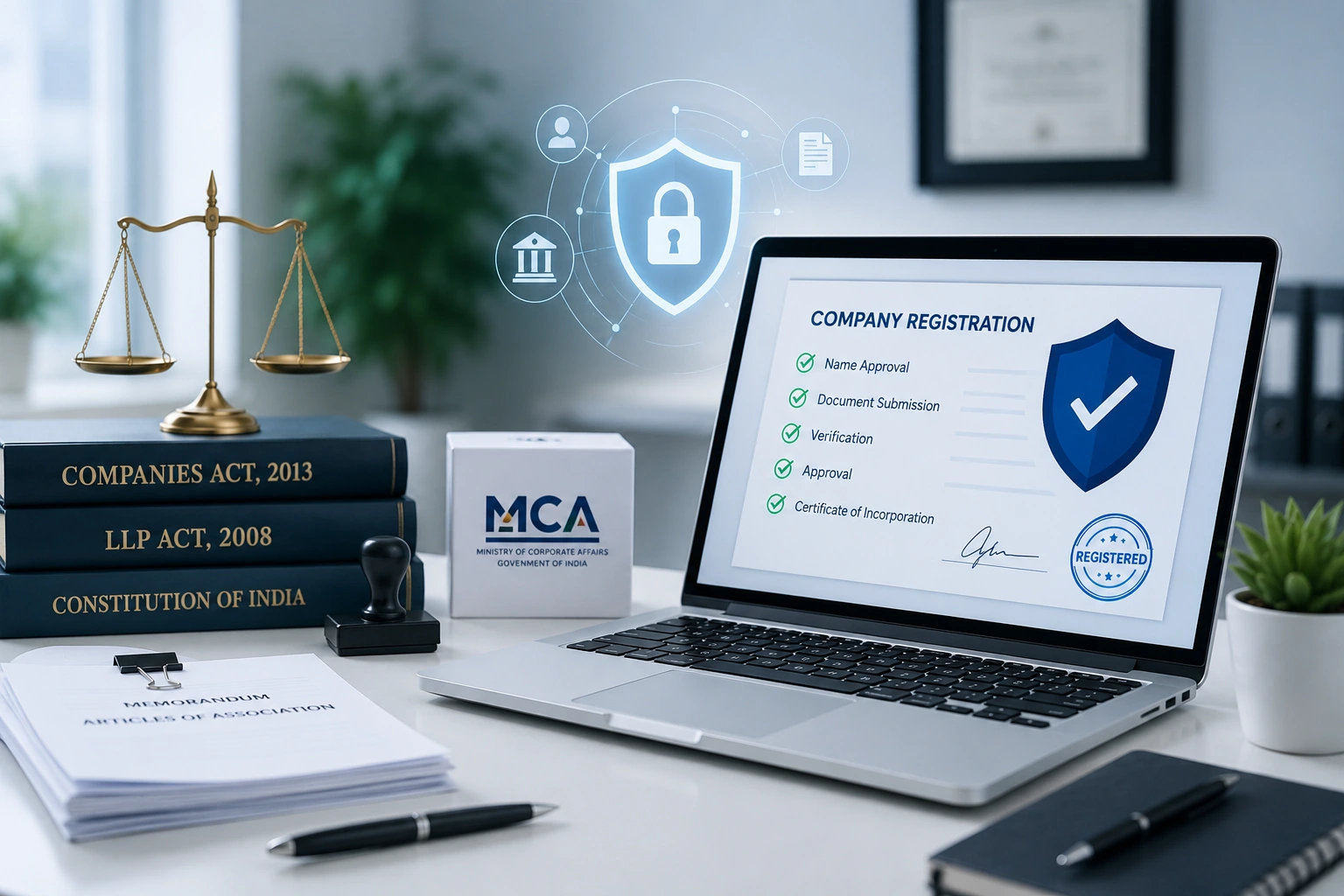
]]>The registration process itself is legally recognised and completed online. However, problems can arise when business owners share documents with unknown agents, accept unclear pricing or lose control of their login details.
So, the real question is not only whether online registration is safe. You should also ask whether the person handling your registration is reliable.
What Makes Online Company Registration Safe?
Companies in India are registered through the Ministry of Corporate Affairs, commonly known as the MCA. The MCA provides the official SPICe+ system for company incorporation and name reservation.
Several checks make the process secure:
- Applications are submitted through the official MCA system.
- Digital Signature Certificates are used to sign online forms.
- Directors and company details go through verification.
- A Corporate Identification Number, or CIN, is issued to the registered company.
- Company details can be checked through MCA Master Data.
- The Registrar of Companies maintains official company records.
A Digital Signature Certificate helps confirm the identity of the person signing and filing the documents. The MCA requires an approved DSC for electronic filings made through its system.
Once the registration is approved, the company receives its official incorporation details. MCA also provides public tools to find a company’s CIN and check its registration status.
What Are the Risks of Online Company Registration?
The official registration system is secure, but using the wrong service provider can create problems.
1. Fake Registration Consultants
Some agents collect money and documents but do not complete the registration. Others may claim to be qualified professionals without providing any proof.
Before hiring someone, verify their identity, office details, professional qualification and previous work.
2. Misuse of Personal Documents
Company registration may require documents such as PAN, identity proof, address proof, photographs and registered-office documents.
Sharing these documents through unsecured messaging apps or with unknown people can increase the risk of misuse. Add a clear watermark such as “For company registration only” before sharing copies wherever appropriate.
3. Hidden Charges
Some service providers advertise company registration at a very low price but do not clearly mention government fees, stamp duty, Digital Signature Certificate charges or professional fees.
Always ask for a written quotation that clearly separates:
- Government fees
- Professional fees
- Stamp duty
- Digital Signature charges
- Additional compliance costs
Do not make payment until you understand what is included.
4. Loss of Email and Login Access
Your company’s registered email address, mobile number and MCA account details should remain under your control.
Avoid allowing a consultant to use an email address or mobile number that you cannot access. Important notices, verification messages and compliance updates may be sent to these contact details.
5. Incorrect Information in the Application
Wrong details about directors, business activities, shareholding or the registered office can cause delays and future compliance problems.
Review all forms carefully before they are signed and submitted. Never sign blank forms or approve an application without checking its details.
How to Register Your Company Safely Online
Follow these simple steps to make your online company registration safer.
Work With a Verified Professional
Choose a Chartered Accountant, Company Secretary or another qualified professional with clear contact details and experience in company incorporation.
Ask who will prepare, review and submit your application.
Request a Complete Cost Breakdown
Get the full cost in writing before starting. Confirm whether the quotation includes government fees, stamp duty, DSC, PAN, TAN and professional charges.
SPICe+ supports several connected incorporation services, including company registration, DIN, PAN and TAN, depending on the application.
Share Documents Securely
Use secure email, a protected client portal or another trusted method to share personal documents.
Do not share:
- OTPs with unknown people
- Internet banking passwords
- Blank signed documents
- Unprotected copies of personal documents
- Digital Signature passwords without proper control
Keep Control of Your Contact Details
Use your own active email address and mobile number for registration. Make sure you receive application updates and verification messages directly.
Also, keep copies of payment receipts, submitted forms and acknowledgement numbers.
Check Everything Before Submission
Review the following details carefully:
- Proposed company name
- Directors’ names and addresses
- Shareholding percentage
- Business activity
- Registered-office address
- Email address and mobile number
Ask the professional to explain anything you do not understand.
Verify the Company After Registration
After approval, check the company details on the MCA portal.
MCA Master Data can show details such as the company name, CIN, registered state and current status. The MCA also provides a separate search facility to find a company’s CIN by name.
You should also collect copies of important documents, including:
- Certificate of Incorporation
- Corporate Identification Number
- Company PAN
- Company TAN
- Memorandum of Association
- Articles of Association
- Digital Signature details
- Submitted incorporation forms
How to Choose a Trusted Registration Professional
Before hiring someone for online company registration, check whether they:
- Have a valid professional qualification
- Provide clear office and contact details
- Give a written scope of work
- Explain government and professional fees separately
- Use secure methods to collect documents
- Provide invoices and payment receipts
- Share application updates
- Offer post-registration compliance support
A reliable professional will not pressure you to make an immediate payment or hide important details. They will explain the process, answer your questions and allow you to review the application before submission.

Final Verdict: Is Online Company Registration Safe?
Online company registration is safe and legally recognised in India when it is completed through the official MCA process.
The biggest risks usually come from unverified agents, unsafe document sharing, hidden fees and incorrect information. These risks can be reduced by working with a qualified professional, keeping control of your email and mobile number, reviewing every document and verifying the completed registration on the MCA portal.
Taking a few simple precautions can protect your personal details and help you start your company correctly.
Need Help Registering Your Company?
Our CA team can assist you with company incorporation, document preparation, MCA filing and post-registration compliance.
Get clear guidance, transparent pricing and professional support throughout the registration process.
Speak with our CA team to start your company registration safely.
Frequently Asked Questions
Q1. Is online company registration legally valid in India?
Yes. A company registered through the official MCA incorporation process is legally recognised after the application is approved and incorporation details are issued.
Q2. Is it safe to share PAN and identity documents for registration?
It is generally safe when documents are shared with a verified professional through a secure method. Add a purpose-specific watermark and avoid sending documents to unknown agents.
Q3. How can I check whether my company is registered?
You can use the MCA Master Data or Find CIN facility to search for the company and check its registration details.
Q4. Can a registration agent misuse my documents?
There is a risk when documents are shared with an unknown or unverified person. Verify the professional, watermark document copies and never sign blank forms.
Q5. Should I hire a CA for company registration?
Professional help can reduce filing errors and make the process easier. A CA can also guide you about tax registration, accounting and compliance requirements after incorporation.
The post Is Online Company Registration Safe in India? first appeared on AmarParul Ventures (OPC) Pvt. Ltd.
]]>The post CA Services for Startups in Mumbai: Complete Guide for New Businesses first appeared on AmarParul Ventures (OPC) Pvt. Ltd.
]]>This is where professional CA services for startups in Mumbai become important.
A Chartered Accountant does much more than filing tax returns. A CA helps you choose the right business structure, complete registration, manage GST, maintain accounts, file returns, prepare financial reports, plan taxes, and stay compliant from the beginning.
For a startup, the right CA guidance can save time, avoid penalties, reduce confusion, and build a strong financial foundation.
Why Startups in Mumbai Need CA Services
A startup needs proper guidance from day one because one wrong decision can create problems later. Choosing the wrong business structure, missing GST registration, not maintaining accounts, or ignoring compliance can affect growth, funding, taxation, and business credibility.
A CA helps startups with the practical side of business, such as registration, accounting, tax filing, GST return filing, ROC compliance, financial reports, business advisory, and funding documents.
For a new business, CA support is not just about compliance. It is about building the business correctly from the start.
What CA Services Does a Startup Need?
Every startup is different. Some need company registration. Some need GST. Some need accounting and tax filing. Some need financial reports for loans or investors.
But in most cases, startups in Mumbai usually need these CA services.

Business Registration and Structure Guidance
Before starting, every founder must decide the right business structure. This decision affects taxation, liability, compliance, ownership, investor readiness, and future growth.
A CA can help you understand whether your business should be registered as a Private Limited Company, LLP, Partnership, Proprietorship, or any other suitable structure.
For startups planning to raise funds, add investors, or build a scalable company, Private Limited Company registration is often preferred. For professionals or small businesses that want limited liability with simpler compliance, LLP registration can be a good option.
The right structure depends on your business model, number of founders, funding plans, risk level, and long-term goals.
Pvt Ltd Registration for Startups
Private Limited Company registration is one of the most common options for startups in Mumbai. It gives your business a professional identity and is suitable for founders who want to scale, raise investment, or work with larger clients.
A CA helps with name approval, documentation, PAN, TAN, MOA, AOA, director details, shareholder structure, and post-registration compliance.
This is important because registration is not just about getting a company certificate. After registration, the company also needs proper accounting, ROC filing, tax filing, and compliance records.
LLP Registration for New Businesses
LLP registration is useful for small businesses, consultants, service providers, and professional firms that want limited liability and a formal business structure.
Compared to a Private Limited Company, an LLP usually has a simpler compliance structure. However, it still needs proper documentation, LLP agreement, annual filing, income tax filing, and accounting records.
A CA can help you decide whether LLP is suitable for your startup or whether you should choose another structure.
MSME Registration for Startup Benefits
MSME registration is useful for small businesses and startups because it gives formal recognition to the business. It can also help in loan applications, government schemes, tenders, and business credibility.
Many new business owners ignore MSME registration because they do not know its practical benefits. A CA can guide whether your business is eligible and help complete the registration correctly.
IEC Registration for Import Export Startups
If your startup deals with import, export, international trading, ecommerce exports, or global clients, IEC registration may be required.
IEC registration helps businesses carry out import-export activities legally. A CA can guide you with documentation and help avoid errors in the registration process.
GST Registration for Startups
GST registration is one of the most common areas where startup founders get confused.
Not every startup needs GST registration from day one. It depends on business type, turnover, services, interstate supply, ecommerce activity, and client requirements.
A CA helps you understand whether GST registration is required for your startup. If registration is needed, the CA can help with proper documentation, application, GST login setup, and compliance guidance.
Getting GST registration without understanding future filing responsibilities can create problems. That is why proper CA guidance is important before applying.
GST Return Filing and Compliance
Once your startup is registered under GST, regular GST return filing becomes important. Missing GST returns can lead to penalties, notices, blocked compliance, and unnecessary stress.
A CA helps with GST return filing, input tax credit checking, invoice records, sales and purchase reconciliation, tax payment guidance, and GST compliance.
For startups, GST compliance should be managed regularly, not at the last moment. Clean GST records also help during audits, loan applications, and business reviews.
Accounting Services for Startups
Accounting is the backbone of every business. Without proper accounts, a startup cannot understand profit, expenses, cash flow, tax liability, or financial position.
A CA helps startups maintain computerized accounting, sales records, purchase records, expense tracking, bank reconciliation, vendor records, customer records, and monthly reports.
Proper accounting helps founders know where the money is going and whether the business is actually making profit.
Corporate Accounting and Financial Records
As your startup grows, basic bookkeeping is not enough. You need proper corporate accounting and structured financial records.
This includes ledger management, balance sheet preparation, profit and loss statement, cash flow tracking, receivables, payables, and financial reporting.
These records are useful for tax filing, GST filing, ROC compliance, business loans, investor discussions, and management decisions.
A startup with clean books looks more professional and trustworthy.
Financial Reports for Startups
Financial reports help founders make better decisions. Many startups fail to track their numbers properly and only look at bank balance. That is not enough.
A CA can help prepare important reports like profit and loss statement, balance sheet, cash flow statement, receivables report, payables report, expense report, and business performance report.
These reports help you understand:
where your revenue is coming from,
where your expenses are increasing,
how much profit you are making,
how much money is blocked,
and whether the business is financially healthy.
Financial Analysis for Better Business Planning
Financial analysis helps startups understand their business in a deeper but practical way.
A CA can review your revenue, costs, margins, cash flow, break-even point, and working capital needs. This helps founders make better decisions about pricing, hiring, expansion, loans, and investments.
For a startup, financial analysis is very useful because it prevents decisions based only on guesswork.
Income Tax Return Filing for Startups
Every startup needs proper income tax filing based on its business structure. A Private Limited Company, LLP, Partnership, and Proprietorship all have different tax filing requirements.
A CA helps with income tax return filing, business expense claims, tax calculation, advance tax guidance, tax audit applicability, and correct return submission.
Wrong income tax filing can create notices, penalties, and future compliance issues. That is why startups should maintain proper accounts and file returns on time.
Taxation Advisory for New Businesses
Tax planning should not start at the end of the financial year. It should start from the beginning.
A CA helps startups plan taxes legally and practically. This includes business expense planning, GST and income tax coordination, advance tax planning, founder tax planning, and compliance calendar management.
Good taxation advisory helps startups avoid unnecessary tax pressure and maintain better cash flow.
Tax Saving Investment Guidance
Startup founders also need personal and business tax planning. Many founders mix personal and business finances, which creates confusion during tax filing and accounting.
A CA can guide you on tax-saving investments, personal tax planning, founder withdrawals, salary planning, and separation of business and personal expenses.
This helps maintain financial clarity and tax discipline.
ROC and Corporate Compliance for Startups
If your startup is registered as a Private Limited Company or LLP, compliance does not stop after registration.
There are regular filings and records that need to be maintained. This may include annual filing, financial statement filing, director KYC, board records, statutory registers, LLP annual filing, and other compliance requirements.
A CA helps startups manage ROC compliance and avoid penalties due to missed filings.
Many founders realize this only after receiving notices or penalties. It is better to manage compliance from the beginning.
Corporate Governance Advisory
For startups planning to grow, raise funds, or work with investors, corporate governance becomes important.
This includes proper founder agreements, shareholding clarity, board documentation, internal controls, approvals, compliance records, and financial discipline.
Good governance builds trust with investors, banks, partners, and clients.
A CA can help startups create a more structured and reliable business setup.
Finance and Funding Support for Startups
Many startups need funds for business growth, working capital, expansion, machinery, office setup, or operations.
For this, proper financial documents are very important.
A CA can help with financial projections, project finance, corporate finance advisory, trade finance, unsecured business loan documentation, bank proposal support, and cash flow planning.
Banks and investors usually need clear numbers before making a decision. A CA helps present those numbers properly.
Detailed Project Report and Feasibility Report
If your startup is applying for a business loan, project finance, or investor support, you may need a Detailed Project Report or Techno-Economic Feasibility Report.
These reports explain your business model, project cost, revenue plan, expenses, profitability, repayment capacity, and financial projections.
A well-prepared report can improve the quality of your loan or funding application.
Business Advisory for Startup Growth
A CA can also help startups with business advisory, not only compliance work.
This includes cost control, pricing decisions, profitability improvement, cash flow planning, business strategy, and financial decision support.
For a startup founder, this guidance is very useful because every decision affects money, tax, and growth.
A good CA does not only ask for documents. A good CA helps you understand your business numbers in simple language.
When Should a Startup Contact a CA?
A startup should contact a CA before making important business decisions, not only when the filing deadline is near.
You should contact a CA:
before business registration,
before GST registration,
before signing major business contracts,
before applying for a business loan,
before raising funds,
before filing tax returns,
when accounts are not updated,
after receiving a GST or income tax notice,
and before planning business expansion.
Early CA guidance can prevent many costly mistakes.
Common Mistakes Startups Make Without CA Guidance
Many startups face problems because they delay professional financial guidance.
Common mistakes include choosing the wrong business structure, not registering for GST when required, mixing personal and business expenses, not maintaining invoices, missing ROC filing, filing returns late, ignoring tax planning, not preparing financial reports, and applying for loans without proper documents.
These mistakes may look small in the beginning, but they can create bigger issues later.
How to Choose the Right CA Firm for Startups in Mumbai
When choosing a CA firm for your startup, do not look only for return filing. Choose a CA firm that can guide you across registration, GST, accounting, tax filing, compliance, financial reports, loan documents, and business advisory.
A startup needs a CA who can explain things clearly, manage compliance properly, and guide the founder at every stage.
The right CA firm should help you stay compliant, understand your numbers, and make better financial decisions.
Complete CA Services Checklist for Startups
| Startup Need | CA Service Required |
| Starting a business | Pvt Ltd, LLP, MSME or IEC Registration |
| GST compliance | GST Registration and GST Return Filing |
| Daily financial records | Computerized Accounting |
| Company accounting | Corporate Accounting |
| Tax filing | Income Tax Return Filing |
| Business reports | Financial Reports and Financial Analysis |
| Business loan support | Project Finance and Loan Documentation |
| Investor or bank documents | Detailed Project Report and Feasibility Report |
| Tax planning | Taxation Advisory and Tax Saving Guidance |
| Growth planning | Business Advisory and Corporate Advisory |
| Compliance control | ROC and Corporate Governance Advisory |
Conclusion
CA services for startups in Mumbai are not only about filing returns. A startup needs the right financial and compliance support from the beginning.
From business registration, GST, accounting, income tax filing, ROC compliance, financial reports, taxation advisory, project finance, and business advisory, a CA helps founders build a strong and compliant business.
If you are starting a new business in Mumbai, professional CA guidance can help you avoid mistakes, save time, manage compliance, and make better financial decisions from day one.
FAQs on CA Services for Startups in Mumbai
Q1. Do startups need a CA in Mumbai?
Yes, startups need a CA for business registration, GST, accounting, tax filing, compliance, financial reports, and advisory. A CA helps founders manage legal and financial responsibilities correctly.
Q2. Which CA services are required for a new business?
A new business may need company registration, GST registration, accounting, income tax filing, ROC compliance, financial reporting, tax planning, and business advisory depending on its structure and activity.
Q3. Is GST registration compulsory for startups?
GST registration depends on your business type, turnover, interstate supply, ecommerce activity, and client requirements. A CA can check whether GST registration is required for your startup.
Q4. Which is better for a startup, LLP or Private Limited Company?
Private Limited Company is usually suitable for startups planning to scale or raise funds. LLP is suitable for businesses that want limited liability with simpler compliance. The right choice depends on your business goals.
Q5. Can a CA help with startup funding documents?
Yes, a CA can help prepare financial reports, projections, detailed project reports, feasibility reports, loan documents, and other financial documents required by banks or investors.
Q6. What happens if a startup misses compliance filing?
Missing compliance filing can lead to penalties, notices, delayed filings, and legal issues. Regular CA support helps startups stay updated with important compliance deadlines.
Q7. How can a CA help in business growth?
A CA helps with financial analysis, tax planning, cost control, cash flow management, business advisory, financial reports, and funding documentation. This helps founders make better business decisions.
The post CA Services for Startups in Mumbai: Complete Guide for New Businesses first appeared on AmarParul Ventures (OPC) Pvt. Ltd.
]]>