The post CA Services for Startups in Mumbai: Complete Guide for New Businesses first appeared on AmarParul Ventures (OPC) Pvt. Ltd.
]]>This is where professional CA services for startups in Mumbai become important.
A Chartered Accountant does much more than filing tax returns. A CA helps you choose the right business structure, complete registration, manage GST, maintain accounts, file returns, prepare financial reports, plan taxes, and stay compliant from the beginning.
For a startup, the right CA guidance can save time, avoid penalties, reduce confusion, and build a strong financial foundation.
Why Startups in Mumbai Need CA Services
A startup needs proper guidance from day one because one wrong decision can create problems later. Choosing the wrong business structure, missing GST registration, not maintaining accounts, or ignoring compliance can affect growth, funding, taxation, and business credibility.
A CA helps startups with the practical side of business, such as registration, accounting, tax filing, GST return filing, ROC compliance, financial reports, business advisory, and funding documents.
For a new business, CA support is not just about compliance. It is about building the business correctly from the start.
What CA Services Does a Startup Need?
Every startup is different. Some need company registration. Some need GST. Some need accounting and tax filing. Some need financial reports for loans or investors.
But in most cases, startups in Mumbai usually need these CA services.

Business Registration and Structure Guidance
Before starting, every founder must decide the right business structure. This decision affects taxation, liability, compliance, ownership, investor readiness, and future growth.
A CA can help you understand whether your business should be registered as a Private Limited Company, LLP, Partnership, Proprietorship, or any other suitable structure.
For startups planning to raise funds, add investors, or build a scalable company, Private Limited Company registration is often preferred. For professionals or small businesses that want limited liability with simpler compliance, LLP registration can be a good option.
The right structure depends on your business model, number of founders, funding plans, risk level, and long-term goals.
Pvt Ltd Registration for Startups
Private Limited Company registration is one of the most common options for startups in Mumbai. It gives your business a professional identity and is suitable for founders who want to scale, raise investment, or work with larger clients.
A CA helps with name approval, documentation, PAN, TAN, MOA, AOA, director details, shareholder structure, and post-registration compliance.
This is important because registration is not just about getting a company certificate. After registration, the company also needs proper accounting, ROC filing, tax filing, and compliance records.
LLP Registration for New Businesses
LLP registration is useful for small businesses, consultants, service providers, and professional firms that want limited liability and a formal business structure.
Compared to a Private Limited Company, an LLP usually has a simpler compliance structure. However, it still needs proper documentation, LLP agreement, annual filing, income tax filing, and accounting records.
A CA can help you decide whether LLP is suitable for your startup or whether you should choose another structure.
MSME Registration for Startup Benefits
MSME registration is useful for small businesses and startups because it gives formal recognition to the business. It can also help in loan applications, government schemes, tenders, and business credibility.
Many new business owners ignore MSME registration because they do not know its practical benefits. A CA can guide whether your business is eligible and help complete the registration correctly.
IEC Registration for Import Export Startups
If your startup deals with import, export, international trading, ecommerce exports, or global clients, IEC registration may be required.
IEC registration helps businesses carry out import-export activities legally. A CA can guide you with documentation and help avoid errors in the registration process.
GST Registration for Startups
GST registration is one of the most common areas where startup founders get confused.
Not every startup needs GST registration from day one. It depends on business type, turnover, services, interstate supply, ecommerce activity, and client requirements.
A CA helps you understand whether GST registration is required for your startup. If registration is needed, the CA can help with proper documentation, application, GST login setup, and compliance guidance.
Getting GST registration without understanding future filing responsibilities can create problems. That is why proper CA guidance is important before applying.
GST Return Filing and Compliance
Once your startup is registered under GST, regular GST return filing becomes important. Missing GST returns can lead to penalties, notices, blocked compliance, and unnecessary stress.
A CA helps with GST return filing, input tax credit checking, invoice records, sales and purchase reconciliation, tax payment guidance, and GST compliance.
For startups, GST compliance should be managed regularly, not at the last moment. Clean GST records also help during audits, loan applications, and business reviews.
Accounting Services for Startups
Accounting is the backbone of every business. Without proper accounts, a startup cannot understand profit, expenses, cash flow, tax liability, or financial position.
A CA helps startups maintain computerized accounting, sales records, purchase records, expense tracking, bank reconciliation, vendor records, customer records, and monthly reports.
Proper accounting helps founders know where the money is going and whether the business is actually making profit.
Corporate Accounting and Financial Records
As your startup grows, basic bookkeeping is not enough. You need proper corporate accounting and structured financial records.
This includes ledger management, balance sheet preparation, profit and loss statement, cash flow tracking, receivables, payables, and financial reporting.
These records are useful for tax filing, GST filing, ROC compliance, business loans, investor discussions, and management decisions.
A startup with clean books looks more professional and trustworthy.
Financial Reports for Startups
Financial reports help founders make better decisions. Many startups fail to track their numbers properly and only look at bank balance. That is not enough.
A CA can help prepare important reports like profit and loss statement, balance sheet, cash flow statement, receivables report, payables report, expense report, and business performance report.
These reports help you understand:
where your revenue is coming from,
where your expenses are increasing,
how much profit you are making,
how much money is blocked,
and whether the business is financially healthy.

Financial Analysis for Better Business Planning
Financial analysis helps startups understand their business in a deeper but practical way.
A CA can review your revenue, costs, margins, cash flow, break-even point, and working capital needs. This helps founders make better decisions about pricing, hiring, expansion, loans, and investments.
For a startup, financial analysis is very useful because it prevents decisions based only on guesswork.
Income Tax Return Filing for Startups
Every startup needs proper income tax filing based on its business structure. A Private Limited Company, LLP, Partnership, and Proprietorship all have different tax filing requirements.
A CA helps with income tax return filing, business expense claims, tax calculation, advance tax guidance, tax audit applicability, and correct return submission.
Wrong income tax filing can create notices, penalties, and future compliance issues. That is why startups should maintain proper accounts and file returns on time.
Taxation Advisory for New Businesses
Tax planning should not start at the end of the financial year. It should start from the beginning.
A CA helps startups plan taxes legally and practically. This includes business expense planning, GST and income tax coordination, advance tax planning, founder tax planning, and compliance calendar management.
Good taxation advisory helps startups avoid unnecessary tax pressure and maintain better cash flow.
Tax Saving Investment Guidance
Startup founders also need personal and business tax planning. Many founders mix personal and business finances, which creates confusion during tax filing and accounting.
A CA can guide you on tax-saving investments, personal tax planning, founder withdrawals, salary planning, and separation of business and personal expenses.
This helps maintain financial clarity and tax discipline.
ROC and Corporate Compliance for Startups
If your startup is registered as a Private Limited Company or LLP, compliance does not stop after registration.
There are regular filings and records that need to be maintained. This may include annual filing, financial statement filing, director KYC, board records, statutory registers, LLP annual filing, and other compliance requirements.
A CA helps startups manage ROC compliance and avoid penalties due to missed filings.
Many founders realize this only after receiving notices or penalties. It is better to manage compliance from the beginning.
Corporate Governance Advisory
For startups planning to grow, raise funds, or work with investors, corporate governance becomes important.
This includes proper founder agreements, shareholding clarity, board documentation, internal controls, approvals, compliance records, and financial discipline.
Good governance builds trust with investors, banks, partners, and clients.
A CA can help startups create a more structured and reliable business setup.
Finance and Funding Support for Startups
Many startups need funds for business growth, working capital, expansion, machinery, office setup, or operations.
For this, proper financial documents are very important.
A CA can help with financial projections, project finance, corporate finance advisory, trade finance, unsecured business loan documentation, bank proposal support, and cash flow planning.
Banks and investors usually need clear numbers before making a decision. A CA helps present those numbers properly.
Detailed Project Report and Feasibility Report
If your startup is applying for a business loan, project finance, or investor support, you may need a Detailed Project Report or Techno-Economic Feasibility Report.
These reports explain your business model, project cost, revenue plan, expenses, profitability, repayment capacity, and financial projections.
A well-prepared report can improve the quality of your loan or funding application.
Business Advisory for Startup Growth
A CA can also help startups with business advisory, not only compliance work.
This includes cost control, pricing decisions, profitability improvement, cash flow planning, business strategy, and financial decision support.
For a startup founder, this guidance is very useful because every decision affects money, tax, and growth.
A good CA does not only ask for documents. A good CA helps you understand your business numbers in simple language.
When Should a Startup Contact a CA?
A startup should contact a CA before making important business decisions, not only when the filing deadline is near.
You should contact a CA:
before business registration,
before GST registration,
before signing major business contracts,
before applying for a business loan,
before raising funds,
before filing tax returns,
when accounts are not updated,
after receiving a GST or income tax notice,
and before planning business expansion.
Early CA guidance can prevent many costly mistakes.
Common Mistakes Startups Make Without CA Guidance
Many startups face problems because they delay professional financial guidance.
Common mistakes include choosing the wrong business structure, not registering for GST when required, mixing personal and business expenses, not maintaining invoices, missing ROC filing, filing returns late, ignoring tax planning, not preparing financial reports, and applying for loans without proper documents.
These mistakes may look small in the beginning, but they can create bigger issues later.
How to Choose the Right CA Firm for Startups in Mumbai
When choosing a CA firm for your startup, do not look only for return filing. Choose a CA firm that can guide you across registration, GST, accounting, tax filing, compliance, financial reports, loan documents, and business advisory.
A startup needs a CA who can explain things clearly, manage compliance properly, and guide the founder at every stage.
The right CA firm should help you stay compliant, understand your numbers, and make better financial decisions.
Complete CA Services Checklist for Startups
| Startup Need | CA Service Required |
| Starting a business | Pvt Ltd, LLP, MSME or IEC Registration |
| GST compliance | GST Registration and GST Return Filing |
| Daily financial records | Computerized Accounting |
| Company accounting | Corporate Accounting |
| Tax filing | Income Tax Return Filing |
| Business reports | Financial Reports and Financial Analysis |
| Business loan support | Project Finance and Loan Documentation |
| Investor or bank documents | Detailed Project Report and Feasibility Report |
| Tax planning | Taxation Advisory and Tax Saving Guidance |
| Growth planning | Business Advisory and Corporate Advisory |
| Compliance control | ROC and Corporate Governance Advisory |
Conclusion
CA services for startups in Mumbai are not only about filing returns. A startup needs the right financial and compliance support from the beginning.
From business registration, GST, accounting, income tax filing, ROC compliance, financial reports, taxation advisory, project finance, and business advisory, a CA helps founders build a strong and compliant business.
If you are starting a new business in Mumbai, professional CA guidance can help you avoid mistakes, save time, manage compliance, and make better financial decisions from day one.
FAQs on CA Services for Startups in Mumbai
Q1. Do startups need a CA in Mumbai?
Yes, startups need a CA for business registration, GST, accounting, tax filing, compliance, financial reports, and advisory. A CA helps founders manage legal and financial responsibilities correctly.
Q2. Which CA services are required for a new business?
A new business may need company registration, GST registration, accounting, income tax filing, ROC compliance, financial reporting, tax planning, and business advisory depending on its structure and activity.
Q3. Is GST registration compulsory for startups?
GST registration depends on your business type, turnover, interstate supply, ecommerce activity, and client requirements. A CA can check whether GST registration is required for your startup.
Q4. Which is better for a startup, LLP or Private Limited Company?
Private Limited Company is usually suitable for startups planning to scale or raise funds. LLP is suitable for businesses that want limited liability with simpler compliance. The right choice depends on your business goals.
Q5. Can a CA help with startup funding documents?
Yes, a CA can help prepare financial reports, projections, detailed project reports, feasibility reports, loan documents, and other financial documents required by banks or investors.
Q6. What happens if a startup misses compliance filing?
Missing compliance filing can lead to penalties, notices, delayed filings, and legal issues. Regular CA support helps startups stay updated with important compliance deadlines.
Q7. How can a CA help in business growth?
A CA helps with financial analysis, tax planning, cost control, cash flow management, business advisory, financial reports, and funding documentation. This helps founders make better business decisions.
The post CA Services for Startups in Mumbai: Complete Guide for New Businesses first appeared on AmarParul Ventures (OPC) Pvt. Ltd.
]]>The post How to Start a Business Legally in India first appeared on AmarParul Ventures (OPC) Pvt. Ltd.
]]>Whether you are launching a startup, opening a small business, starting an online company, or working as a freelancer, understanding the legal process is important for long-term success. Proper registration not only gives your business a legal identity but also helps build trust with customers, investors, and financial institutions.
If you are planning to start a business legally in India, this guide explains everything you need to know from choosing the right business structure to GST registration, licenses, compliance requirements, and professional support.
Businesses that want proper legal guidance often prefer working with experienced company registration services to avoid delays and compliance issues during the registration process.
Why Starting a Business Legally in India Is Important
Many small businesses begin informally, especially home businesses, freelancers, and local startups. However, operating without proper registration can create difficulties as the business grows.
A legally registered business offers several advantages:
- Builds trust among customers and vendors
- Helps open a business bank account
- Makes GST registration easier
- Improves loan and funding eligibility
- Protects the business from legal penalties
- Creates a professional business image
- Supports long-term business growth
Businesses with proper legal registration also find it easier to apply for government schemes, partnerships, and financial support.
Professional business advisory services can help entrepreneurs choose the right structure and avoid common legal mistakes during the early stages of business setup.
Step 1: Choose the Right Business Structure
One of the most important decisions while starting a business legally in India is selecting the right business structure. The structure affects taxation, compliance, ownership, liability, and future expansion opportunities.
Sole Proprietorship
A sole proprietorship is suitable for:
- Small businesses
- Freelancers
- Local shops
- Home businesses
It is one of the easiest and most affordable business structures in India. The owner and the business are treated as the same legal entity.
Benefits:-
- Easy to start
- Low compliance
- Simple taxation process
Limitations:-
- Unlimited personal liability
- Difficult to raise investment
- Limited scalability
Partnership Firm
A partnership firm is suitable when two or more people want to run a business together.
Benefits:-
- Shared responsibilities
- Easy setup process
- Flexible operations
Limitations:-
- Shared liabilities
- Possible partner disputes
- Limited legal protection
Limited Liability Partnership (LLP)
An LLP combines the flexibility of a partnership with liability protection.
Benefits:-
- Limited liability protection
- Separate legal identity
- Better business credibility
Best For:-
- Professional firms
- Consulting businesses
- Growing startups
Private Limited Company
A private limited company is one of the most preferred structures for startups and growing businesses.
Benefits:-
- Strong legal identity
- Investor-friendly structure
- Better funding opportunities
- Limited liability protection
Limitations:-
- Higher compliance requirements
- Regular ROC filings
- Structured legal process
Entrepreneurs planning future expansion often choose professional company incorporation services to ensure the registration process is completed correctly.
One Person Company (OPC)
An OPC is designed for solo entrepreneurs who want the benefits of a corporate structure without multiple shareholders.
Benefits:-
- Limited liability
- Separate legal identity
- Better professional image
Suitable For:-
- Solo founders
- Consultants
- Individual startups
Comparison of Business Structures in India
| Business Type | Liability | Compliance | Best For |
| Sole Proprietorship | Unlimited | Low | Small businesses |
| Partnership Firm | Shared | Moderate | Family or partner businesses |
| LLP | Limited | Moderate | Service businesses |
| Private Limited Company | Limited | Higher | Startups and growing businesses |
| OPC | Limited | Moderate | Solo entrepreneurs |
Step 2: Decide Your Business Name
Your business name plays an important role in branding and legal identity.
Before finalizing a name:
- Check MCA name availability
- Verify trademark conflicts
- Check domain availability
- Ensure the name matches your business activity
Choosing a unique and professional business name improves credibility and helps create a strong market presence.
Businesses planning long-term brand growth should also consider trademark protection during the early stages.
Step 3: Prepare the Required Documents
The documentation process is an important part of legal business registration in India.
Common documents required include:
- PAN card
- Aadhaar card
- Passport-size photographs
- Address proof
- Business address proof
- Utility bill
- NOC from property owner (if applicable)
For private limited companies and LLPs, additional documents may also be required.
Professional startup registration services can simplify the documentation and approval process significantly.
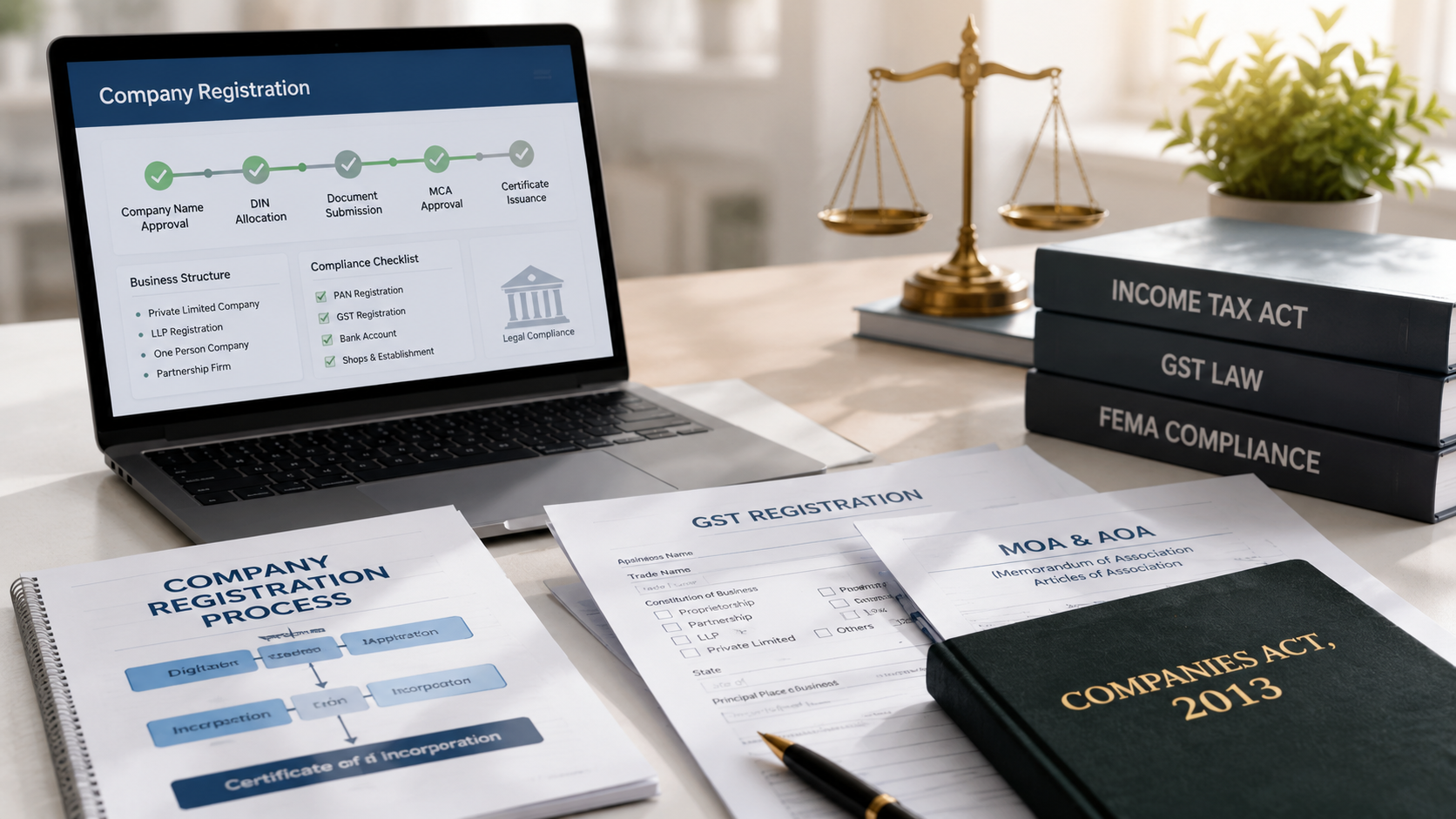
Step 4: Register Your Business Legally
Once the structure and documents are ready, the next step is completing the registration process.
The registration process usually includes:
- Digital Signature Certificate (DSC)
- Director Identification Number (DIN)
- Name approval
- Incorporation filing
- PAN and TAN generation
- Certificate of Incorporation
Today, most business registration processes in India can be completed online through the MCA portal.
However, errors in documentation or filing often delay approvals. This is why many startups prefer experienced legal business registration support to complete the process smoothly.
Step 5: Apply for GST Registration
GST registration is one of the most important legal requirements for businesses in India.
You may need GST registration if:
- Your turnover crosses the prescribed limit
- You sell products or services across states
- You run an online business
- You work with GST-registered companies
Benefits of GST Registration
- Legal tax compliance
- Input tax credit benefits
- Improved business credibility
- Easier B2B operations
Ignoring GST requirements can lead to penalties and compliance problems later.
Businesses often work with professional taxation advisory services to manage GST registration and filing properly.
Step 6: Obtain Necessary Licenses and Permits
Different businesses may require different licenses depending on the industry and operations.
Some common licenses include:
- MSME Registration
- Shop and Establishment License
- FSSAI License
- Professional Tax Registration
- Import Export Code (IEC)
- Trade License
For example:
- Food businesses require FSSAI approval
- Export businesses require IEC registration
- Retail stores may require local trade licenses
Understanding licensing requirements early helps avoid legal issues later.
Step 7: Open a Business Bank Account
A separate business bank account is important for maintaining financial transparency.
Using a personal account for business transactions can create accounting and taxation complications.
Benefits of a Business Account
- Better bookkeeping
- Easier tax filing
- Professional transactions
- Improved financial tracking
Most banks require:
- PAN card
- Business registration proof
- GST certificate (if applicable)
- Address proof
Step 8: Maintain Proper Accounting and Compliance
Many businesses focus only on registration and ignore compliance after setup. This creates serious issues later.
Legal business compliance includes:
- GST filing
- Income tax filing
- ROC filing
- TDS compliance
- Accounting records
- Annual returns
Proper accounting helps businesses:
- Track financial performance
- Avoid penalties
- Improve tax planning
- Maintain legal compliance
Growing businesses usually prefer professional accounting and compliance services to manage regular filings and financial records efficiently.
Common Legal Mistakes New Businesses Make
Many startups face legal and financial problems because of avoidable mistakes.
Some common mistakes include:
Choosing the Wrong Business Structure
Selecting the wrong structure can increase taxation and compliance burdens later.
Delaying GST Registration
Late GST registration may result in penalties and loss of input tax benefits.
Ignoring Compliance Deadlines
Missing filing deadlines can create unnecessary legal notices and penalties.
Mixing Personal and Business Finances
This creates accounting confusion and affects business transparency.
Ignoring Trademark Protection
Without trademark registration, businesses may face future branding disputes.
Professional startup compliance services can help businesses avoid these issues from the beginning.
How Much Does It Cost to Start a Business Legally in India?
The cost depends on the business structure and registration requirements.
Approximate Costs
| Registration Type | Estimated Cost |
| Sole Proprietorship | Low |
| Partnership Firm | Moderate |
| LLP Registration | Moderate |
| Private Limited Company | Higher |
| GST Registration | Usually affordable |
Additional costs may include:
- Professional fees
- License fees
- Compliance costs
- Trademark registration
- Accounting expenses
Businesses planning funding or loan applications may also require proper financial documents and project report preparation services for better financial planning.
How Long Does Business Registration Take in India?
The timeline depends on the business structure and document readiness.
Estimated Timelines
| Process | Estimated Time |
| Sole Proprietorship | Few days |
| Partnership Firm | 5–10 days |
| LLP Registration | 10–15 days |
| Private Limited Company | 10–20 days |
| GST Registration | 7–10 days |
Proper documentation and professional support can help speed up the approval process.
Why Professional CA Guidance Matters for New Businesses
Starting a business legally involves more than registration alone. Entrepreneurs must also understand taxation, compliance, documentation, accounting, and financial planning.
Professional support helps businesses:
- Avoid legal mistakes
- Choose the right structure
- Complete registrations correctly
- Maintain compliance
- Improve tax planning
- Build long-term financial stability
Experienced CA services for businesses can simplify the entire process and help startups focus more on growth instead of paperwork.
Businesses looking for professional assistance can also contact our CA experts for registration, taxation, and compliance support.
Final Thoughts
Starting a business legally in India is one of the smartest decisions for long-term growth and stability. A properly registered business creates trust, improves financial opportunities, and protects entrepreneurs from future legal problems.
From choosing the right business structure to GST registration, accounting, compliance, and taxation, every step plays an important role in building a strong business foundation.
Whether you are launching a startup, opening a small business, or expanding your operations, working with experienced professionals can make the entire process smoother and more efficient.
Reliable business registration and compliance solutions can help businesses stay legally secure while focusing on growth and success.
Frequently Asked Questions
Can I start a business without registration in India?
Yes, some small businesses start informally, but legal registration is recommended for taxation, banking, compliance, and long-term growth.
Which business structure is best for startups?
Private Limited Company and LLP structures are commonly preferred for startups because they offer better legal protection and scalability.
Is GST mandatory for every business?
No. GST registration depends on turnover limits and business activity. However, many businesses voluntarily register for operational benefits.
Can I register a company online in India?
Yes. Most business registrations in India can now be completed online through the MCA portal.
What licenses are required for small businesses?
The requirement depends on the industry. Common licenses include MSME registration, Shop and Establishment License, GST registration, and FSSAI approval.
Why is accounting important for new businesses?
Proper accounting helps businesses manage taxes, maintain compliance, track profits, and avoid financial problems in the future.
The post How to Start a Business Legally in India first appeared on AmarParul Ventures (OPC) Pvt. Ltd.
]]>