The post How CA Firms Help Startups During Company Registration in India first appeared on AmarParul Ventures (OPC) Pvt. Ltd.
]]>Should you register as a Private Limited Company, LLP or OPC? How should ownership be divided between founders? Is GST registration required immediately? What should be mentioned as the company’s business activity? What compliance starts after incorporation?
These decisions can affect taxation, fundraising, ownership, accounting and future compliance.
This is where working with a CA for startup registration can be valuable. A Chartered Accountant can help founders understand the financial and compliance impact of their decisions before they become part of the company’s structure.
Here is where a CA firm can practically help during the startup company registration process.
1. Choosing the Right Business Structure Before Registration
One of the first decisions a founder needs to make is the type of entity to register.
Common options include:
- Private Limited Company
- Limited Liability Partnership (LLP)
- One Person Company (OPC)
- Partnership or proprietorship in suitable cases
There is no single structure that works for every startup.
A technology startup planning to raise external funding may have very different requirements from a consulting firm where two partners want to operate the business together and distribute profits.
A CA can help founders evaluate factors such as taxation, ownership, compliance requirements, future investment plans and the expected size of the business.
For example, choosing an LLP simply because it appears easier to manage may not be the right decision if the founders plan to bring in equity investors later.
Likewise, registering a Private Limited Company without understanding its ongoing compliance requirements can create unnecessary administrative work for a very small business.
The objective should be to select a structure that supports both the current business model and future plans.
2. Reviewing Founder, Director and Ownership Details
Ownership is another area that deserves careful attention before registration.
Founders should clearly understand:
- who will become a director
- who will become a shareholder
- how ownership will be divided
- how much initial capital will be introduced
- whether investors may be added later
- how future dilution could affect existing founders
Many early-stage businesses decide shareholding percentages casually because the company is still small.
However, those percentages can become extremely important during fundraising, founder exits, valuation discussions or future ownership changes.
A CA can help founders understand the financial impact of the proposed shareholding structure.
Where shareholder agreements, vesting arrangements or other legal rights are involved, founders may also need advice from an appropriate legal professional.
The important point is simple: ownership should be planned before incorporation rather than treated as another field in the registration form.
3. Checking Registration Documents Before MCA Filing
Company incorporation requires multiple details and supporting documents.
Problems often happen not because founders completely forget a document, but because the information across those documents does not match.
For example, there may be differences in names, addresses or other identification details. Registered-office documents may be incomplete, or a utility bill may not meet the required conditions.
A CA firm assisting with startup company registration in India can review the information before the incorporation application is filed.
This may include checking director and shareholder details, address documents, registered-office proof, capital information and the proposed business activities.
A proper review can reduce unnecessary corrections and resubmissions.
For founders, this means less time spent repeatedly fixing basic documentation issues after the application has already moved into processing.
4. Defining the Company’s Business Activities Correctly
One area founders often overlook is the description of what the company will actually do.
It may sound simple, but the company’s proposed business activities should reflect both the current business model and reasonably expected activities.
Suppose a startup develops software but also plans to provide consulting, subscription-based SaaS services and technology implementation.
Its business description should be considered carefully rather than using a vague sentence copied from another company.
A CA can work with the founders to understand the commercial model and help identify the relevant financial and compliance considerations.
The company’s activities may later have an impact on areas such as GST, invoicing, banking, accounting classification and industry-specific registrations.
Getting this clarity early makes the financial setup easier after incorporation.
5. Supporting the SPICe+ Incorporation Process
Most founders do not need to become experts in every MCA form.
What they do need is a clear understanding of what information is being submitted on their behalf.
The SPICe+ incorporation process covers important company details such as the proposed name, registered office, directors, subscribers, capital and other incorporation information.
A CA supporting the registration process can help founders organise and verify the financial and business-related information needed for these filings.
Before submission, founders should personally verify critical information such as:
- company name
- founder and director names
- registered-office address
- shareholding
- authorised and paid-up capital
- business activities
- email address and contact information
Never assume that these details are too small to review.
Correcting avoidable errors after filing is usually more difficult than checking them before submission.
6. Planning Tax and GST Requirements Early
Receiving a Certificate of Incorporation does not automatically mean every tax registration is required from day one.
This is another area where CA guidance becomes useful.
A CA can understand how the startup plans to operate and determine which tax requirements may become applicable.
Important questions may include:
Will the business sell goods or services?
Will it sell across different states?
Will it operate through an ecommerce marketplace?
What turnover does the business expect?
Will it make payments that could attract TDS?
Will there be employees, consultants or vendors?
Does the business need GST registration immediately, or does registration depend on its activities and applicable rules?
A professional approach should not be about obtaining every registration possible.
It should be about understanding which registrations actually apply to the business and when.
This can save founders from unnecessary compliance as well as missed obligations.
7. Setting Up Accounting From Day One
This is where many new businesses make a preventable mistake.
They register the company, open a bank account and begin operating but postpone accounting until several months later.
By then, invoices may be missing, founder expenses may be mixed with company expenses and bank transactions may not have proper supporting records.
A CA firm can help create a basic accounting system soon after incorporation.
This can include setting up the chart of accounts, recording founder capital, documenting incorporation expenses, maintaining sales and purchase records and establishing a process for bank reconciliation.
Good accounting from the beginning helps the startup understand its real financial position.
It also makes future tax filing, GST compliance, audits, fundraising and financial reporting considerably easier.
A founder should be able to answer a basic question at any time:
How much money has the business earned, spent, received and still owes?
Proper accounting makes that possible.
8. Understanding Post-Incorporation Compliance
Company registration is the beginning of compliance, not the end.
Once the company is incorporated, various obligations may arise depending on the entity, business activities and applicable regulations.
This can include accounting, ROC-related compliance, tax filings, GST compliance where applicable, TDS, payroll-related obligations and annual filings.
The exact requirements will vary from one business to another.
This is why startups should discuss a compliance calendar with their CA immediately after registration.
Instead of reacting to each deadline separately, founders can know in advance what needs to be done during the year.
A structured compliance process becomes especially useful as the business starts hiring employees, dealing with more vendors and processing a larger number of transactions.
9. Understanding Udyam and DPIIT Recognition
Company incorporation, Udyam registration and DPIIT Startup Recognition are not the same thing.
This distinction is important.
Company registration creates the legal business entity.
Udyam registration relates to MSME recognition for eligible businesses.
DPIIT recognition is connected to the Startup India framework and has its own eligibility requirements.
Not every business automatically requires or qualifies for every registration.
A CA can help founders understand which registrations may be relevant to their business, what financial information may be required and what compliance responsibilities can follow.
This prevents founders from treating every available certificate as something they must obtain immediately.
10. Decisions a CA Helps Founders Get Right Early
The real value of a CA during startup registration is often not the form filing itself.
It is the quality of the decisions made before and immediately after incorporation.
A CA can help founders think through questions such as:
Entity structure: Does the proposed structure match the business and future funding plans?
Ownership: Has the shareholding structure been considered properly?
Capital: How much initial capital should be introduced and how will it be recorded?
Tax: What tax registrations and obligations may apply?
Accounting: How will transactions be recorded from the first day?
Business activity: Does the registered activity properly reflect what the company intends to do?
Compliance: What filings and records will need ongoing attention?
These decisions can influence the company for years.
That is why startup registration should be approached as a business setup exercise rather than only a documentation exercise.
11. What a Good CA Should Ask Before Registering Your Startup
A useful consultation should involve more than asking founders to send PAN cards and address proofs.
A CA should first try to understand the business.
For example:
What exactly will the company sell?
Who are the founders?
How will ownership be divided?
Will the company seek investment?
Will the business sell outside Maharashtra or across India?
Will it have employees?
Will it operate through ecommerce platforms?
Are any directors, shareholders or investors based outside India?
What revenue does the business expect?
Will GST registration be required immediately?
Are there any sector-specific licences?
These questions help the CA understand what the startup may need beyond incorporation.
If the entire discussion is limited only to documents, founders may be missing an important part of the planning process.
12. When Should a Startup Speak to a CA?
Ideally, before filing the registration application.
The better sequence is:
Business idea → business model → entity structure → ownership → tax and compliance review → documentation → incorporation → accounting and compliance setup
Consulting a CA after everything has already been registered limits the opportunity to review early structural decisions.
It is usually easier to make informed choices at the beginning than to restructure the business later.
CA Support Does Not Stop After Registration
As the startup begins operations, its financial requirements become more complex.
It may need support with bookkeeping, GST, TDS, payroll, income tax, financial reporting, ROC compliance and business planning.
This is why many startups prefer working with a CA firm that understands the business from the incorporation stage.
The CA already knows how the company is structured, how ownership was planned and what registrations are applicable.
That continuity can make ongoing compliance easier for founders.
Frequently Asked Questions
Q1. Do I need a CA to register a startup company in India?
Company incorporation can involve different eligible professionals depending on the specific certification or filing requirement. However, founders often work with a Chartered Accountant because registration decisions also involve taxation, capital, accounting and future compliance.
Q2. Should I consult a CA before choosing between an LLP and Private Limited Company?
Ideally, yes. The right structure depends on factors such as ownership, tax position, compliance requirements, fundraising plans and how the founders intend to operate the business.
Q3. Can a CA help decide founder shareholding?
A CA can help explain the financial implications of the proposed ownership structure and future dilution. Where detailed shareholder rights or founder agreements are involved, legal advice may also be appropriate.
Q4. Can a CA help with GST registration after incorporation?
Yes. A CA can review the startup’s activities and determine whether GST registration is applicable based on the business model and relevant requirements.
Q5. Is Startup India registration the same as company registration?
No. Incorporating a company creates the legal entity. DPIIT Startup Recognition under Startup India is a separate process for eligible businesses.
Q6. What should founders discuss with a CA before company registration?
Discuss the business model, proposed entity type, ownership, directors, initial capital, tax requirements, expected turnover, GST applicability, future investment plans and post-registration compliance.
Q7. Can a CA help after the company is registered?
Yes. CA firms commonly support startups with accounting, tax, GST, TDS, payroll, financial reporting, ROC compliance and other ongoing financial requirements.
Q8. When is the best time to consult a CA for startup registration?
Before incorporation. Early consultation allows the founder to review the business structure, ownership, tax implications and compliance requirements before registration details are finalised.
Starting Correctly Is Easier Than Fixing the Structure Later
The role of a CA during startup registration goes much further than submitting documents.
The real value lies in helping founders understand how early decisions can affect taxation, ownership, accounting, fundraising and future compliance.
A startup that begins with the right structure, clear financial records and a realistic compliance plan is easier to manage as it grows.
If you are planning to register a startup in Mumbai or Navi Mumbai, AmarParul Ventures can help you understand the appropriate business structure, registration requirements, taxation considerations and post-incorporation compliance before you begin.
The post How CA Firms Help Startups During Company Registration in India first appeared on AmarParul Ventures (OPC) Pvt. Ltd.
]]>The post Pvt Ltd Registration Cost in Mumbai (2026 Guide) first appeared on AmarParul Ventures (OPC) Pvt. Ltd.
]]>The answer is not one fixed amount.
Your total cost can include MCA filing charges, company name reservation, Maharashtra stamp duty, Digital Signature Certificates (DSCs), and professional fees. The amount can also change based on your authorised share capital, number of directors or subscribers, and whether any special documentation is required.
That is why two consultants may quote very different prices for apparently the same company registration.
This guide breaks down the Pvt Ltd registration cost in Mumbai so you can understand what you are actually paying for before choosing a registration service.
Pvt Ltd Registration Cost in Mumbai: Quick Breakdown
For a normal private limited company in Mumbai, the cost can broadly be divided into the following parts:
| Cost Component | What You Are Paying For |
| Company name reservation | Reserving the proposed company name |
| SPICe+ incorporation fee | MCA incorporation filing, where applicable |
| Maharashtra stamp duty | Stamp duty on MOA and AOA |
| DSC | Digital signatures required for incorporation |
| DIN | Director identification through incorporation |
| PAN & TAN | Tax registrations issued with incorporation |
| Professional fee | Documentation, filing and professional assistance |
SPICe+ is the MCA’s integrated company incorporation system. It combines incorporation with services such as DIN allotment and mandatory PAN and TAN issuance.
The important point is that government fees and professional fees are not the same thing.
Whenever you receive a company registration quotation, check whether the price shown is only the consultant’s fee or the total amount including statutory expenses.
1. MCA and SPICe+ Registration Fees
Private limited companies are incorporated through the Ministry of Corporate Affairs using SPICe+.
Under the current fee structure, the normal SPICe+ incorporation filing fee is generally nil for companies having authorised share capital up to ₹15 lakh, although state stamp duty and other applicable expenses still have to be paid.
This is where founders often get confused.
A consultant may say that there is “zero company registration fee”, but that does not mean your entire Pvt Ltd registration in Mumbai is free.
You can still have costs for:
name reservation + Maharashtra stamp duty + DSC + professional assistance + any special documentation
For higher authorised capital, additional MCA fees may apply according to the applicable fee structure.
2. Company Name Reservation Cost
Before incorporation, your proposed company name needs to be approved.
The current government fee for company name reservation through the MCA process is ₹1,000 per application.
This makes name selection more important than it may appear.
If the proposed name is too similar to an existing company or conflicts with naming requirements, it can create delays and may require another application.
Before filing, it is therefore sensible to check:
whether the name is already used by another company, whether it is too similar to an existing trademark, and whether it correctly represents the proposed business activity.
Doing this properly can reduce unnecessary resubmission.
3. Maharashtra Stamp Duty for Pvt Ltd Registration
This is one of the most important parts of the private limited company registration cost in Mumbai because stamp duty is state-specific.
A company incorporated with its registered office in Mumbai falls under Maharashtra’s applicable stamp-duty framework.
Under the current Maharashtra Stamp Act position, stamp duty on the Articles of Association (AOA) is calculated at 0.3% of share capital, subject to the statutory maximum. The rate was increased from the earlier 0.2% level.
For a Memorandum of Association filed along with the Articles of Association, current 2026 guidance based on the Maharashtra framework identifies a ₹1,000 MOA stamp duty.
The Maharashtra Department of Registration and Stamps also maintains an updated article-wise Maharashtra Stamp Act schedule, with a version dated 22 July 2026 available on its official portal.
Example: ₹1 Lakh Authorised Capital
Suppose you are registering a private limited company in Mumbai with:
Authorised capital: ₹1,00,000
At an AOA duty rate of 0.3%, the AOA component would work out to:
₹1,00,000 × 0.3% = ₹300
Add the applicable MOA duty of ₹1,000, and the MOA/AOA stamp-duty component would be approximately:
₹1,300
This example shows why authorised capital matters when estimating the actual Pvt Ltd registration fees in Maharashtra.
4. Does Authorised Capital Affect Registration Cost?
Yes, it can.
Authorised capital is the maximum share capital that the company is authorised to issue under its constitutional documents.
From a registration-cost perspective, higher authorised capital can affect applicable filing fees and, importantly in Maharashtra, stamp duty on the Articles of Association.
For example:
A company with ₹1 lakh authorised capital and another company with ₹10 lakh authorised capital should not automatically expect exactly the same statutory cost.
At the current Maharashtra AOA rate, higher share capital means a higher AOA stamp-duty amount, subject to the statutory cap.
This is why a registration quotation should always mention the authorised capital on which the price has been calculated.
5. Digital Signature Certificate Cost
Company incorporation is completed electronically, so the relevant signatories need valid Digital Signature Certificates (DSCs) to digitally sign incorporation documents.
DSC charges are not a universal government-fixed incorporation package price. They can vary depending on the certifying authority, validity period, service provider, and number of DSCs required.
This is another reason why the number of people involved in incorporation can change the final cost.
For example, if additional proposed directors or subscribers require new DSCs, your DSC-related expense may be higher than that of a company with fewer signatories.
When comparing registration quotations, check whether DSC charges are included or charged separately.
6. Are DIN, PAN and TAN Separate Registration Costs?
SPICe+ was created to combine several registrations into one incorporation process.
The integrated system provides company incorporation along with DIN allotment and mandatory PAN and TAN issuance, among other linked services.
Current registration guidance also indicates that DIN can be allotted as part of the SPICe+ incorporation process rather than requiring every new director to complete a completely separate incorporation-stage application.
This matters when comparing quotes.
Be careful if a package creates the impression that routine integrated registrations are expensive standalone services without clearly explaining the actual government charge and the professional work involved.
7. Why Do Pvt Ltd Registration Quotes in Mumbai Vary So Much?
Suppose one consultant advertises:
Pvt Ltd Registration – ₹4,999
and another quotes:
₹9,999
The ₹4,999 package is not automatically cheaper.
The first quotation might cover only professional filing assistance, while additional statutory expenses are billed separately.
The second quotation might already include several items.
Before comparing prices, find out whether the quotation includes:
MCA charges, name reservation, Maharashtra stamp duty, DSC, MOA/AOA preparation and professional fees.
The right comparison is not:
“Which consultant has the lowest headline price?”
It is:
“What is included in the final amount I will actually pay?”
That small difference can prevent surprises during registration.
8. What Can Increase the Final Pvt Ltd Registration Cost?
A straightforward Indian-owned private limited company with simple shareholding can cost less to process than a more complex structure.
Your final company registration cost in Mumbai can increase because of factors such as higher authorised capital, more signatories requiring DSCs, additional documentation, name-related issues or special shareholder structures.
Foreign shareholders or directors can also require additional documentation and authentication formalities depending on the circumstances.
The main lesson is simple: ask for a quotation based on your actual proposed company structure, not just an advertised starting price.
9. Costs That May Not Be Included in Basic Company Registration
Another common mistake is assuming that company incorporation covers every compliance your business will ever need.
It does not.
Services such as trademark registration, accounting, bookkeeping, annual ROC compliance, income-tax return preparation, specialised licences and ongoing advisory work may be separate from basic incorporation.
Some registrations are integrated into SPICe+ where applicable, but that does not make all future business compliance part of the original registration package. SPICe+ itself combines multiple incorporation-related services, including PAN, TAN and certain other registrations.
So before making payment, ask exactly where the Pvt Ltd registration service ends and ongoing compliance begins.
10. How to Read a Pvt Ltd Registration Quotation
A transparent quotation should make the calculation easy to understand:
Company name reservation
- MCA filing charges, if applicable
- Maharashtra stamp duty
- DSC charges
- Professional registration fee
- Any case-specific additional work
= Estimated total registration cost
If you receive only one number without any explanation, ask for a breakup.
A good quotation should clearly answer five questions:
- Are government charges included in the price?
- Is Maharashtra stamp duty included?
- Are DSC charges included for all required signatories?
- What authorised capital has been assumed?
- Are there any additional or post-incorporation charges?
These questions make it much easier to compare company registration services on an equal basis.
Pvt Ltd Registration Cost in Mumbai: What Should You Budget For?
There is no sensible single price that applies to every private limited company.
For a relatively simple Mumbai incorporation with authorised capital within the applicable MCA fee-exemption range, the normal SPICe+ incorporation fee itself may be nil, but name reservation, Maharashtra stamp duty, DSC and professional services can still create an actual registration cost.
Therefore, instead of asking only:
“What is your company registration price?”
ask:
“What will be my total registration cost based on my authorised capital, directors, shareholders and registered office in Maharashtra?”
That question gives you a far more useful answer.
If you are planning to register a Private Limited Company in Mumbai, get the cost calculated according to your actual proposed structure before filing. A clear cost breakup can help you understand the government charges, Maharashtra stamp duty, professional fees and any additional requirements before you make a decision.
Frequently Asked Questions
Q1. How much does Pvt Ltd registration cost in Mumbai in 2026?
There is no single fixed total cost. The final amount depends on factors such as authorised capital, Maharashtra stamp duty, company name reservation, DSC requirements and professional fees. The normal SPICe+ incorporation filing fee is currently generally nil for companies with authorised capital up to ₹15 lakh, but other costs still apply.
Q2. What is the government fee for Pvt Ltd registration?
Government-related costs can include the applicable MCA filing fee, name reservation and state stamp duty. The current company-name reservation fee is ₹1,000, while the SPICe+ incorporation filing fee is generally nil within the current authorised-capital exemption limit.
Q3. Is Maharashtra stamp duty included in company registration fees?
Stamp duty is payable according to the applicable Maharashtra rules and should be checked separately when reviewing a quotation. Whether a consultant includes it in an advertised package depends on the package terms.
Q4. Does authorised capital affect Pvt Ltd registration cost?
Yes. Authorised capital can affect applicable registration charges and Maharashtra AOA stamp duty. Maharashtra currently applies a 0.3% duty to the relevant share-capital amount under Article 10, subject to the statutory maximum.
Q5. Is DSC included in Pvt Ltd company registration cost?
It depends on the service provider. Some packages include DSC procurement, while others charge it separately. Always check the quotation before making payment.
Q6. Are PAN and TAN issued during company registration?
Yes. SPICe+ integrates mandatory PAN and TAN issuance with the company incorporation process.
Q7. Why are company registration packages priced differently?
Packages can include different components. One may cover only professional fees, while another may include name reservation, stamp duty, DSC and other registration support. Compare the detailed scope instead of comparing only the advertised price.
Important: Government fees, filing procedures and stamp-duty rates can change. The applicable amount should be verified on the MCA portal and the Maharashtra Department of Registration & Stamps at the time of filing.
The post Pvt Ltd Registration Cost in Mumbai (2026 Guide) first appeared on AmarParul Ventures (OPC) Pvt. Ltd.
]]>The post Is Online Company Registration Safe in India? first appeared on AmarParul Ventures (OPC) Pvt. Ltd.
]]>The registration process itself is legally recognised and completed online. However, problems can arise when business owners share documents with unknown agents, accept unclear pricing or lose control of their login details.
So, the real question is not only whether online registration is safe. You should also ask whether the person handling your registration is reliable.
What Makes Online Company Registration Safe?
Companies in India are registered through the Ministry of Corporate Affairs, commonly known as the MCA. The MCA provides the official SPICe+ system for company incorporation and name reservation.
Several checks make the process secure:
- Applications are submitted through the official MCA system.
- Digital Signature Certificates are used to sign online forms.
- Directors and company details go through verification.
- A Corporate Identification Number, or CIN, is issued to the registered company.
- Company details can be checked through MCA Master Data.
- The Registrar of Companies maintains official company records.
A Digital Signature Certificate helps confirm the identity of the person signing and filing the documents. The MCA requires an approved DSC for electronic filings made through its system.
Once the registration is approved, the company receives its official incorporation details. MCA also provides public tools to find a company’s CIN and check its registration status.
What Are the Risks of Online Company Registration?
The official registration system is secure, but using the wrong service provider can create problems.
1. Fake Registration Consultants
Some agents collect money and documents but do not complete the registration. Others may claim to be qualified professionals without providing any proof.
Before hiring someone, verify their identity, office details, professional qualification and previous work.
2. Misuse of Personal Documents
Company registration may require documents such as PAN, identity proof, address proof, photographs and registered-office documents.
Sharing these documents through unsecured messaging apps or with unknown people can increase the risk of misuse. Add a clear watermark such as “For company registration only” before sharing copies wherever appropriate.
3. Hidden Charges
Some service providers advertise company registration at a very low price but do not clearly mention government fees, stamp duty, Digital Signature Certificate charges or professional fees.
Always ask for a written quotation that clearly separates:
- Government fees
- Professional fees
- Stamp duty
- Digital Signature charges
- Additional compliance costs
Do not make payment until you understand what is included.
4. Loss of Email and Login Access
Your company’s registered email address, mobile number and MCA account details should remain under your control.
Avoid allowing a consultant to use an email address or mobile number that you cannot access. Important notices, verification messages and compliance updates may be sent to these contact details.
5. Incorrect Information in the Application
Wrong details about directors, business activities, shareholding or the registered office can cause delays and future compliance problems.
Review all forms carefully before they are signed and submitted. Never sign blank forms or approve an application without checking its details.
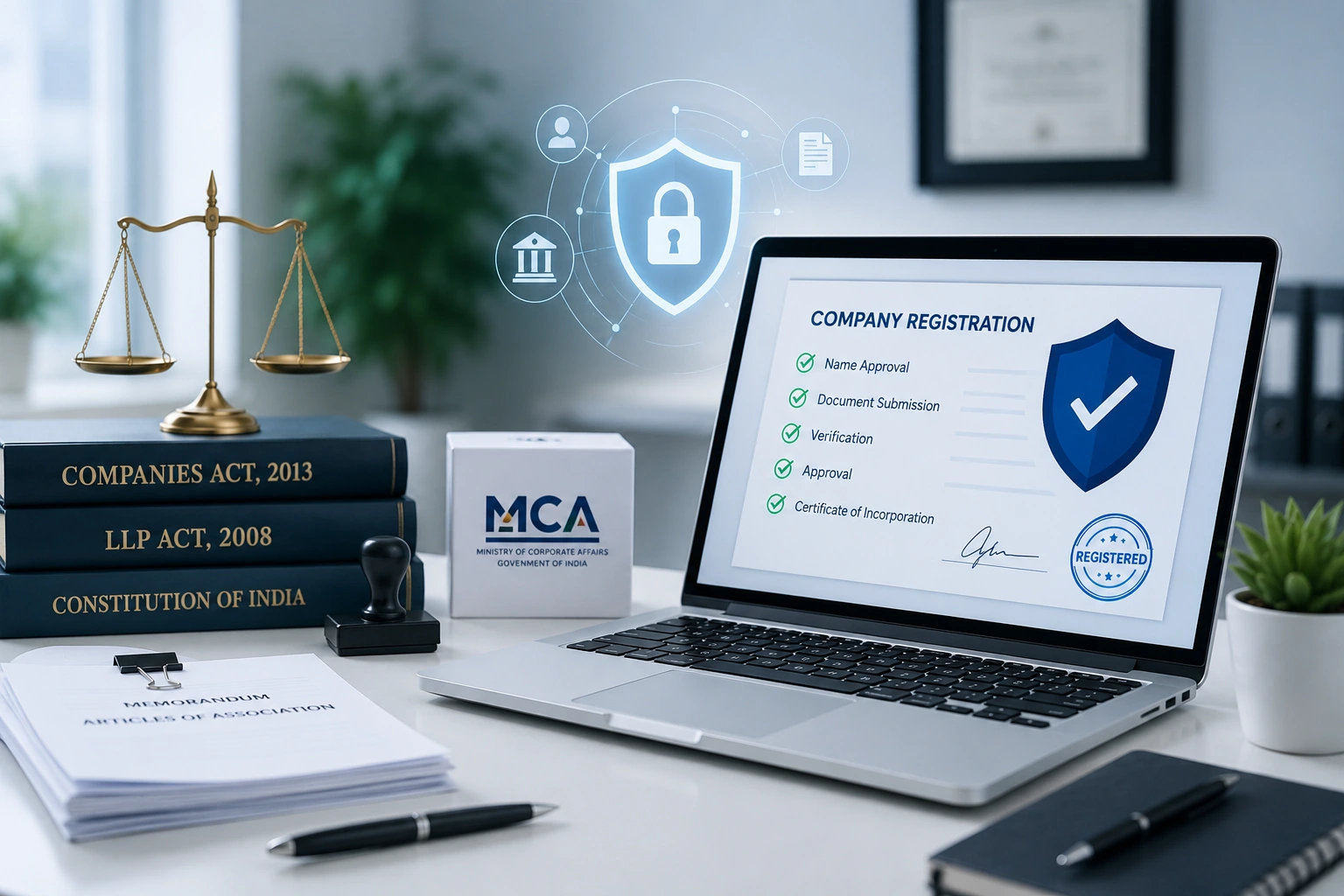
How to Register Your Company Safely Online
Follow these simple steps to make your online company registration safer.
Work With a Verified Professional
Choose a Chartered Accountant, Company Secretary or another qualified professional with clear contact details and experience in company incorporation.
Ask who will prepare, review and submit your application.
Request a Complete Cost Breakdown
Get the full cost in writing before starting. Confirm whether the quotation includes government fees, stamp duty, DSC, PAN, TAN and professional charges.
SPICe+ supports several connected incorporation services, including company registration, DIN, PAN and TAN, depending on the application.
Share Documents Securely
Use secure email, a protected client portal or another trusted method to share personal documents.
Do not share:
- OTPs with unknown people
- Internet banking passwords
- Blank signed documents
- Unprotected copies of personal documents
- Digital Signature passwords without proper control
Keep Control of Your Contact Details
Use your own active email address and mobile number for registration. Make sure you receive application updates and verification messages directly.
Also, keep copies of payment receipts, submitted forms and acknowledgement numbers.
Check Everything Before Submission
Review the following details carefully:
- Proposed company name
- Directors’ names and addresses
- Shareholding percentage
- Business activity
- Registered-office address
- Email address and mobile number
Ask the professional to explain anything you do not understand.
Verify the Company After Registration
After approval, check the company details on the MCA portal.
MCA Master Data can show details such as the company name, CIN, registered state and current status. The MCA also provides a separate search facility to find a company’s CIN by name.
You should also collect copies of important documents, including:
- Certificate of Incorporation
- Corporate Identification Number
- Company PAN
- Company TAN
- Memorandum of Association
- Articles of Association
- Digital Signature details
- Submitted incorporation forms
How to Choose a Trusted Registration Professional
Before hiring someone for online company registration, check whether they:
- Have a valid professional qualification
- Provide clear office and contact details
- Give a written scope of work
- Explain government and professional fees separately
- Use secure methods to collect documents
- Provide invoices and payment receipts
- Share application updates
- Offer post-registration compliance support
A reliable professional will not pressure you to make an immediate payment or hide important details. They will explain the process, answer your questions and allow you to review the application before submission.

Final Verdict: Is Online Company Registration Safe?
Online company registration is safe and legally recognised in India when it is completed through the official MCA process.
The biggest risks usually come from unverified agents, unsafe document sharing, hidden fees and incorrect information. These risks can be reduced by working with a qualified professional, keeping control of your email and mobile number, reviewing every document and verifying the completed registration on the MCA portal.
Taking a few simple precautions can protect your personal details and help you start your company correctly.
Need Help Registering Your Company?
Our CA team can assist you with company incorporation, document preparation, MCA filing and post-registration compliance.
Get clear guidance, transparent pricing and professional support throughout the registration process.
Speak with our CA team to start your company registration safely.
Frequently Asked Questions
Q1. Is online company registration legally valid in India?
Yes. A company registered through the official MCA incorporation process is legally recognised after the application is approved and incorporation details are issued.
Q2. Is it safe to share PAN and identity documents for registration?
It is generally safe when documents are shared with a verified professional through a secure method. Add a purpose-specific watermark and avoid sending documents to unknown agents.
Q3. How can I check whether my company is registered?
You can use the MCA Master Data or Find CIN facility to search for the company and check its registration details.
Q4. Can a registration agent misuse my documents?
There is a risk when documents are shared with an unknown or unverified person. Verify the professional, watermark document copies and never sign blank forms.
Q5. Should I hire a CA for company registration?
Professional help can reduce filing errors and make the process easier. A CA can also guide you about tax registration, accounting and compliance requirements after incorporation.
The post Is Online Company Registration Safe in India? first appeared on AmarParul Ventures (OPC) Pvt. Ltd.
]]>The post Difference Between OPC, LLP and Pvt Ltd Company in India: Which One Should You Choose? first appeared on AmarParul Ventures (OPC) Pvt. Ltd.
]]>At first, all three options may look similar because they offer a separate legal identity and limited liability protection. But when you look closely, there are major differences in ownership, compliance, taxation, funding, credibility, flexibility and long-term business growth.
For example, a solo business owner may prefer an OPC. Two professionals starting a consulting firm may find an LLP more practical. A startup planning to raise funds may choose a Private Limited Company. So, there is no single answer that fits every business.
In this blog, we will explain the difference between OPC, LLP and Pvt Ltd Company in simple words, so you can understand which business structure is suitable for your business before starting the company registration process in India.
What Are OPC, LLP and Private Limited Company?
Before comparing OPC vs LLP vs Pvt Ltd, it is important to understand what each structure means.
What is OPC?
OPC stands for One Person Company. As the name suggests, it is a company that can be started by one person. It is suitable for solo entrepreneurs who want to run a business under a proper company structure without adding another shareholder.
An OPC gives the owner a separate legal identity and limited liability protection. This means the business and the owner are treated separately in the eyes of law. Compared to a proprietorship, an OPC usually gives better credibility because it is registered as a company.
OPC is commonly suitable for individual consultants, freelancers, solo founders, small business owners and professionals who want a formal business structure but do not have partners at the beginning.
However, OPC also has certain limitations. Since it is designed for a single owner, it is not as flexible as a Private Limited Company when it comes to adding investors, co-founders or multiple shareholders.
What is LLP?
LLP stands for Limited Liability Partnership. It is a business structure where two or more partners can run a business together with limited liability protection.
An LLP is different from a traditional partnership firm because it has a separate legal identity. The partners are not personally liable for all business liabilities in the same way as a normal partnership, subject to legal exceptions.
LLP is usually preferred by professionals, consultants, service businesses, agencies, family businesses and small firms where partners want flexibility in profit sharing and management. The internal rules of an LLP are generally governed by an LLP agreement.
One major reason people choose LLP is that it offers more flexibility and generally has a simpler compliance burden compared to a Private Limited Company.
What is Private Limited Company?
A Private Limited Company, commonly called Pvt Ltd, is one of the most popular business structures in India for startups, growing businesses and companies planning expansion.
A Pvt Ltd company has shareholders and directors. Shareholders own the company, while directors manage the company. This structure is more formal and is generally preferred when a business wants to raise funds, issue shares, add investors, create ESOPs or build a scalable company.
Private Limited Companies usually have stronger credibility with investors, banks, corporate clients, vendors and large institutions. But they also come with higher compliance requirements compared to LLP and OPC.
If your business has long-term growth plans, multiple founders, investor funding goals or expansion plans, a Private Limited Company is often the preferred choice.
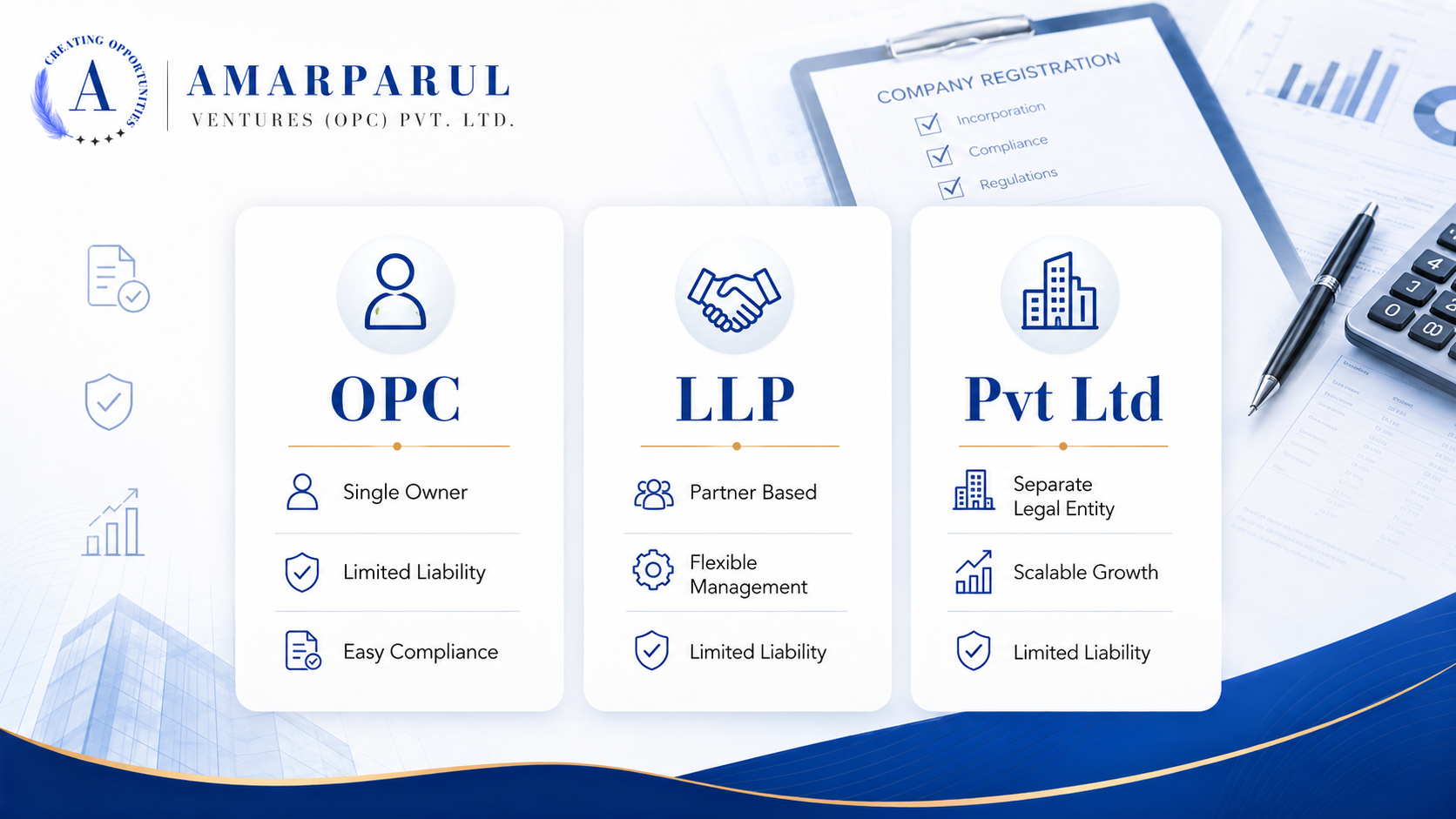
Quick Comparison: OPC vs LLP vs Pvt Ltd
Here is a simple comparison table to understand the difference between OPC, LLP and Pvt Ltd Company.
| Point of Difference | OPC | LLP | Pvt Ltd |
| Full Form | One Person Company | Limited Liability Partnership | Private Limited Company |
| Best Suitable For | Solo business owner | Two or more partners | Startups and growing businesses |
| Minimum Owners | 1 member | 2 partners | 2 shareholders |
| Separate Legal Entity | Yes | Yes | Yes |
| Limited Liability | Yes | Yes | Yes |
| Ownership Structure | Single owner | Partners | Shareholders |
| Management | Director | Designated partners | Directors |
| Compliance Level | Moderate | Generally lower | Higher |
| Funding Friendly | Limited | Less preferred by investors | Highly preferred |
| Investor Entry | Difficult compared to Pvt Ltd | Not ideal for equity funding | Easier through shareholding |
| Suitable for Startups | Good for solo founder | Good for service startups | Best for scalable startups |
| Suitable for Small Business | Yes | Yes | Yes |
| Public Credibility | Good | Good | Strong |
| Flexibility | Limited | High | Structured |
| Conversion Possibility | Can be converted, subject to rules | Can be converted, subject to rules | Already scalable |
This table gives a quick idea, but the right choice depends on your business model, number of owners, future goals and compliance readiness.
Difference Between OPC, LLP and Pvt Ltd Based on Ownership
Ownership is one of the biggest differences between OPC, LLP and Pvt Ltd.
In an OPC, there is only one owner. That person holds the ownership and controls the business. A nominee is also required, but the nominee does not become the owner unless a specific event happens as per the applicable rules.
In an LLP, ownership belongs to the partners. The partners can decide their profit-sharing ratio and responsibilities through the LLP agreement. This makes LLP flexible for professional firms, agencies, consulting businesses and partnerships.
In a Private Limited Company, ownership belongs to shareholders. The company is managed by directors. This structure is more suitable when ownership may change in the future through share transfer, new investment, ESOPs or investor participation.
So, if you are a single owner, OPC can be considered. If you have partners, LLP may be suitable. If you want co-founders, investors and structured ownership, Pvt Ltd is usually better.
Difference Based on Liability Protection
OPC, LLP and Pvt Ltd all provide limited liability protection. This is one of the main reasons entrepreneurs prefer these structures over a simple proprietorship or traditional partnership.
Limited liability means the personal assets of the owner, partners or shareholders are generally protected from business liabilities. However, this protection is not absolute in every situation. If there is fraud, personal guarantee, legal violation, tax default or misuse of the entity, personal responsibility may still arise.
In an OPC, the liability of the member is generally limited to the unpaid amount on shares, if any.
In an LLP, partners usually have limited liability. One partner is generally not personally liable for the independent wrongful act of another partner, subject to the legal facts of the case.
In a Pvt Ltd company, shareholders have limited liability based on their shareholding. The company itself is a separate legal person.
From a practical point of view, all three structures offer better protection than an unregistered business or proprietorship. But proper compliance, accounting, tax filing and documentation are necessary to maintain that protection.
Difference Based on Compliance Requirements
Compliance is a very important factor while choosing between OPC, LLP and Pvt Ltd.
Many business owners only think about registration cost, but the real responsibility starts after registration. Every registered business must maintain proper records, file returns and follow applicable laws.
OPC Compliance
An OPC has moderate compliance requirements. It is simpler than a full Private Limited Company in some cases, but still it is a company, so annual compliance cannot be ignored.
Common OPC compliance may include annual filing, income tax return filing, financial statements, director-related compliance, accounting records and ROC-related filings.
OPC can be a good option for a solo entrepreneur who wants a proper company structure but is ready to handle basic annual compliance.
LLP Compliance
LLP compliance is generally considered simpler compared to a Private Limited Company. An LLP usually needs to file annual returns and a statement of accounts and solvency. It also needs to file income tax returns and maintain proper books of accounts.
Because LLP has fewer corporate governance requirements compared to Pvt Ltd, many small firms and professional businesses prefer LLP.
However, simpler compliance does not mean no compliance. LLPs must still file required forms on time. Delayed filings can lead to penalties.
Pvt Ltd Compliance
A Private Limited Company has more formal compliance requirements. It has to maintain statutory registers, conduct board meetings, appoint an auditor, file annual returns, prepare financial statements, complete ROC filings, maintain books of accounts and follow director-related compliance.
This may sound like extra work, but it also gives Pvt Ltd companies a stronger legal and governance structure. That is why investors, banks and larger clients often prefer dealing with a Private Limited Company.
If you are planning a serious, scalable and investment-ready business, these compliance requirements should be seen as part of building a strong company foundation.
Difference Based on Taxation
Taxation is another important point when comparing OPC vs LLP vs Pvt Ltd. However, it is important to understand one thing clearly: tax should not be the only reason for choosing a business structure.
An LLP and a company are taxed differently. A Private Limited Company is taxed as a domestic company. An LLP is generally taxed under the partnership firm/LLP category. An OPC is also a company, so company taxation rules apply.
The actual tax impact depends on profit, turnover, deductions, business activity, applicable tax regime, surcharge, cess and other provisions. Tax rules may also change from time to time.
Many people ask, “Which is better for tax, LLP or Pvt Ltd?” The answer depends on your business situation. Sometimes LLP may look simple from a tax and compliance point of view. In other cases, Pvt Ltd may be more suitable due to reinvestment, funding, business credibility and long-term planning.
A good CA will not only compare tax rates. They will also check your business model, expected profit, owner withdrawals, funding plans, compliance cost and future conversion possibilities before suggesting the right structure.
Difference Based on Registration Process
OPC, LLP and Pvt Ltd registration can be done online through the MCA process. But the documentation and forms may differ depending on the type of entity.
OPC Registration Process
The basic OPC registration process usually includes:
First, the proposed director needs a Digital Signature Certificate. Then the company name is applied for approval. After that, incorporation documents are prepared, including details of the member, nominee, registered office and business activity. Once the forms are filed and approved, the Certificate of Incorporation is issued.
OPC registration is suitable when one person wants to start a company without bringing in another shareholder.
LLP Registration Process
For LLP registration, the designated partners need Digital Signature Certificates. Name approval is applied through the MCA process. After approval, incorporation forms are filed. Once the LLP is incorporated, the LLP agreement must be prepared and filed within the required timeline.
The LLP agreement is very important because it defines partner rights, profit sharing, duties, capital contribution and decision-making rules.
Pvt Ltd Registration Process
For Private Limited Company registration, directors need Digital Signature Certificates. The name is applied for approval. Then incorporation documents such as MOA and AOA are prepared and filed through the MCA process. After approval, the company receives its Certificate of Incorporation along with PAN and TAN as applicable.
A Pvt Ltd company registration should be planned properly, especially if there are multiple founders, different shareholding ratios or future investors.
Documents Required for OPC, LLP and Pvt Ltd Registration
The documents required may vary based on the case, but generally, the following documents are commonly needed.
For individuals, PAN card, Aadhaar card, photograph, mobile number, email ID, identity proof and address proof are usually required.
For the registered office, an electricity bill or utility bill, rent agreement or ownership proof and NOC from the owner may be needed.
For OPC, nominee details and nominee consent are also required.
For LLP, partner details and LLP agreement are important.
For Pvt Ltd, details of directors, shareholders, shareholding pattern, MOA and AOA are required.
A CA or company registration consultant can help prepare and verify documents properly before filing, so unnecessary rejection or delay can be avoided.
Cost Difference Between OPC, LLP and Pvt Ltd
The cost of registration depends on different factors such as state, stamp duty, professional fees, number of partners or directors, authorised capital, DSC, documentation and additional registrations.
Generally, LLP may have comparatively lower compliance and maintenance cost. OPC may have moderate cost because it is a company structure for a single owner. Pvt Ltd may have higher compliance cost, but it also gives better scalability and credibility.
Here is a simple cost comparison:
| Cost Factor | OPC | LLP | Pvt Ltd |
| Registration Cost | Moderate | Usually moderate | Moderate to higher |
| Annual Compliance Cost | Moderate | Usually lower | Higher |
| Documentation | Moderate | Moderate | More structured |
| Professional Fees | Depends on work | Depends on work | Depends on work |
| Best for Low Compliance | Not the lowest | Better option | Not ideal |
| Best for Growth | Limited | Moderate | Strong |
Many business owners make the mistake of choosing an entity only because registration cost is low. This is not the right approach. A cheaper structure today may become restrictive tomorrow if your business grows, adds investors or changes ownership.
Which is Better for Startups: OPC, LLP or Pvt Ltd?
For startups, the answer depends on the future plan.
If you are a solo founder testing an idea and do not need investors immediately, OPC may work at the beginning.
If two or more people are starting a service-based business, consulting firm, agency or professional practice, LLP can be a practical option because it offers flexibility and limited liability.
If your startup plans to raise funding, issue shares, bring investors, create ESOPs, add co-founders or scale aggressively, Private Limited Company is usually the better structure.
Most investors prefer Pvt Ltd because it has a clear shareholding structure. Equity investment is easier to manage in a company compared to LLP or OPC.
So, if your startup is funding-focused, Pvt Ltd is generally the stronger choice.
Which is Better for Small Business?
For small businesses, there is no one fixed answer. It depends on ownership and future goals.
Choose OPC if you are a single owner and want limited liability with better credibility than a proprietorship.
Choose LLP if you have two or more partners and want flexibility with comparatively simpler compliance.
Choose Pvt Ltd if you want to build a brand, work with bigger clients, raise funds, add shareholders or create a scalable business structure.
For example, a solo digital consultant may choose OPC. Two chartered accountants or consultants may choose LLP. A tech product startup may choose Pvt Ltd.
The best structure is the one that supports your current business and future growth.
OPC vs LLP: Which One Should You Choose?
OPC and LLP are very different because OPC is for one person, while LLP requires at least two partners.
If you are starting alone, LLP is not suitable because LLP needs partners. In that case, OPC may be better if you want a registered company structure.
If you have a business partner and both of you want flexible management and profit sharing, LLP may be better than OPC.
OPC is more suitable for solo entrepreneurs. LLP is more suitable for partnership-based businesses.
LLP vs Pvt Ltd: Which One is Better?
This is one of the most common questions asked by business owners.
LLP is better when you want flexibility, simpler compliance and partner-based management. It is commonly used for consulting businesses, service firms, professional practices and small businesses.
Pvt Ltd is better when you want a scalable business structure, investor funding, shareholding flexibility, stronger corporate credibility and long-term expansion.
If your business is going to remain partner-managed and service-focused, LLP can be a good choice. If your business is going to grow with investors, employees, ESOPs, multiple shareholders and expansion plans, Pvt Ltd is usually better.
OPC vs Pvt Ltd: Which One is Better?
OPC is suitable for one person. Pvt Ltd is suitable for two or more shareholders.
If you are a single owner and want full control, OPC can be a practical option. But if you want to add co-founders, investors or shareholders, Pvt Ltd is better.
A Private Limited Company is more flexible for growth because ownership can be divided into shares. Investors can be added through share allotment or transfer, subject to applicable laws and agreements.
So, OPC is good for a solo start. Pvt Ltd is better for long-term scalability.
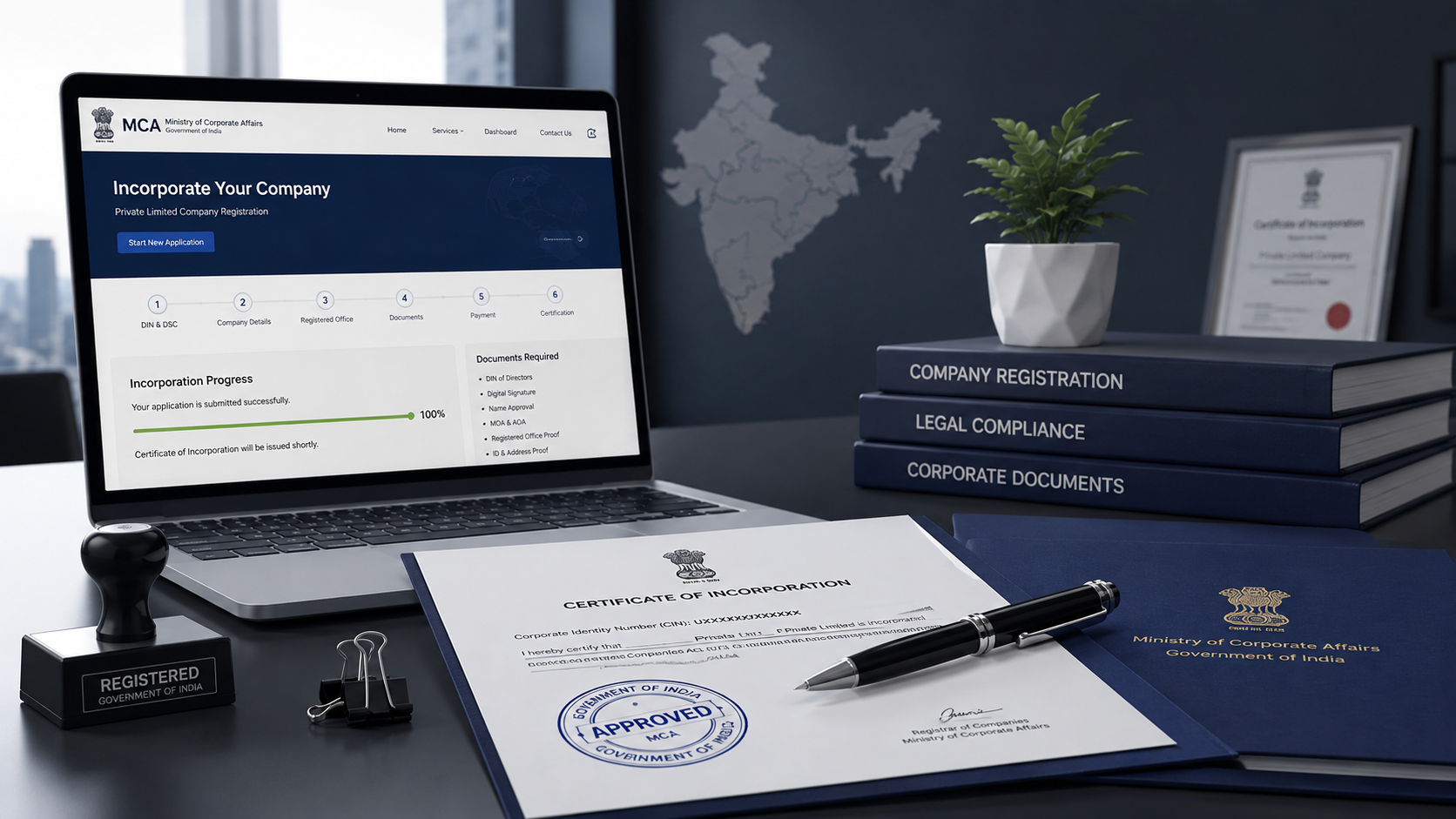
Common Mistakes People Make While Choosing a Business Structure
Many business owners register an entity without proper advice and later face compliance, tax or ownership problems. Here are some common mistakes to avoid.
Some people choose Pvt Ltd only because it sounds bigger, without understanding the compliance cost.
Some choose LLP only because it has simpler compliance, without thinking about future investors.
Some start OPC without considering whether they may need co-founders in the near future.
Some people ignore tax planning and only look at registration charges.
Some do not prepare a proper LLP agreement or shareholders’ understanding.
Some do not check name availability properly.
Some ignore annual compliance after registration and later face penalties.
Some choose a structure based on advice from friends instead of consulting a professional.
The right business structure should be selected after checking ownership, liability, tax, compliance, funding, future expansion and exit planning.
Practical Examples: Which Structure Fits Which Business?
Let us understand with simple examples.
Example 1: Solo Consultant
A single business consultant wants to work with corporate clients and wants better credibility than a proprietorship. In this case, OPC can be a suitable option.
It gives a company structure and limited liability while allowing the person to run the business independently.
Example 2: Two Friends Starting a Marketing Agency
If two friends are starting a marketing agency and want flexible profit sharing, LLP can be suitable.
But if they want to build a large agency, raise funds or add shareholders later, Pvt Ltd may be better.
Example 3: Tech Startup Planning Investor Funding
A technology startup planning to raise investment should usually consider Private Limited Company.
This is because investors generally prefer a proper shareholding structure, which is easier in a Pvt Ltd company.
Example 4: Professional Services Firm
A firm of consultants, architects, tax professionals or advisors may prefer LLP because it gives flexibility and limited liability.
LLP works well where partners are actively involved in business operations.
Example 5: Family-Owned Business
A family business may choose LLP or Pvt Ltd depending on its size and growth plan.
If the business is small and partner-managed, LLP can be suitable. If the family wants to build a larger brand, expand operations and create a formal structure, Pvt Ltd may be better.
Final Decision Guide: OPC, LLP or Pvt Ltd?
Here is a simple decision guide:
| Your Situation | Recommended Structure |
| You are a single owner | OPC |
| You have two or more partners | LLP or Pvt Ltd |
| You want lower compliance | LLP |
| You want investor funding | Pvt Ltd |
| You want to issue shares | Pvt Ltd |
| You are starting a professional firm | LLP |
| You are starting a scalable startup | Pvt Ltd |
| You want full control as a solo owner | OPC |
| You want strong business credibility | Pvt Ltd |
| You want flexible partner profit sharing | LLP |
This table gives general guidance. The final decision should be taken after understanding your business activity, tax position, number of owners, investment plans and compliance capacity.
How a CA Can Help You Choose the Right Business Structure
A CA plays an important role before and after business registration.
A CA can help you compare OPC, LLP and Pvt Ltd based on your actual business advisory & planning. They can guide you on tax impact, compliance cost, documentation, registration process, accounting setup, GST registration, ROC filing and annual compliance.
A professional can also help you avoid mistakes such as choosing the wrong structure, incorrect shareholding, weak LLP agreement, poor documentation or missed compliance deadlines.
If you are confused between OPC, LLP and Pvt Ltd, it is always better to take professional advice before registration rather than correcting mistakes later.
Conclusion
The difference between OPC, LLP and Pvt Ltd Company is not only about registration. It is about ownership, liability, tax, compliance, funding, credibility and future growth.
OPC is suitable for a single owner who wants a company structure.
LLP is suitable for two or more partners who want flexibility and comparatively simpler compliance.
Private Limited Company is suitable for startups, growing businesses and companies planning funding or expansion.
There is no one-size-fits-all answer. The best business structure depends on your business model, number of owners, long-term vision and financial advisory & planning.
If you are planning to register your business but are confused between OPC, LLP and Pvt Ltd, speak with our CA experts. We can help you choose the right structure and complete your business registration process with proper documentation and compliance guidance.
FAQs on Difference Between OPC, LLP and Pvt Ltd
Q1. What is the main difference between OPC, LLP and Pvt Ltd?
The main difference is ownership and business purpose. OPC is suitable for one person. LLP is suitable for two or more partners. Pvt Ltd is suitable for startups and growing businesses that need structured ownership, investors and scalability.
Q2. Which is better: OPC, LLP or Pvt Ltd?
It depends on your business goal. OPC is better for solo entrepreneurs. LLP is better for partner-based businesses and professional firms. Pvt Ltd is better for startups, funding and long-term growth.
Q3. Which has less compliance: LLP or Pvt Ltd?
Generally, LLP has simpler compliance compared to a Private Limited Company. However, LLP still needs proper annual filing, tax filing and accounting.
Q4. Is Pvt Ltd better than LLP?
Pvt Ltd is better if you want funding, shareholders, ESOPs, investor entry and strong corporate credibility. LLP is better if you want flexibility, partner-based management and comparatively simpler compliance.
Q5. Which is better for a single owner: OPC or Pvt Ltd?
For a single owner, OPC is usually more suitable because it is designed for one person. Pvt Ltd requires at least two shareholders.
Q6. Can OPC be converted into Pvt Ltd?
Yes, OPC may be converted into a Private Limited Company subject to applicable rules and conditions. It is better to consult a professional before planning conversion.
Q7. Is LLP good for startups?
LLP can be good for service-based startups, consulting businesses and professional firms. But if a startup is planning to raise investor funding, Pvt Ltd is generally preferred.
Q8. Which is best for funding: LLP or Pvt Ltd?
Private Limited Company is generally better for funding because it has a proper shareholding structure. Investors usually prefer Pvt Ltd companies over LLPs.
Q9. Which is cheaper to maintain: LLP or Pvt Ltd?
LLP is generally cheaper and simpler to maintain compared to Pvt Ltd. However, the actual cost depends on business activity, turnover, compliance requirements and professional support.
Q10. Do I need a CA for OPC, LLP or Pvt Ltd registration?
Yes, it is highly recommended. A CA can help you choose the right structure, prepare documents, complete registration, plan taxes and manage annual compliance properly.
The post Difference Between OPC, LLP and Pvt Ltd Company in India: Which One Should You Choose? first appeared on AmarParul Ventures (OPC) Pvt. Ltd.
]]>The post Best Business Structure for IT Companies in India: A Complete Guide for Startups, Software Companies, and Tech Entrepreneurs first appeared on AmarParul Ventures (OPC) Pvt. Ltd.
]]>Many founders focus heavily on building products, acquiring clients, and growing revenue. However, the legal structure of the business often gets overlooked during the early stages. This can become a costly mistake later when the company starts expanding, attracting investors, hiring employees, or serving international clients.
The business structure you choose affects several important aspects of your company, including taxation, legal liability, compliance requirements, fundraising opportunities, ownership flexibility, and long-term scalability.
A structure that works well for a freelance software developer may not be suitable for a SaaS startup planning to raise venture capital funding. Similarly, a technology consulting firm may have different requirements than a product-based software company.
This raises a common question that many entrepreneurs ask:
Which business structure is best for an IT company in India?
The answer depends on your business goals, growth plans, investment requirements, and operational model. While there is no one-size-fits-all solution, understanding the advantages and limitations of each structure can help you make an informed decision.
In this guide, we will compare all major business structures available for IT companies in India, explain their benefits and drawbacks, and help you determine which option is most suitable for your technology business.
What Is a Business Structure and Why Does It Matter for IT Companies?
A business structure is the legal framework under which a company operates. It defines who owns the business, how profits are taxed, how liabilities are handled, and what legal responsibilities the owners must fulfill.
For an IT company, choosing the right structure is particularly important because technology businesses often experience rapid growth. What starts as a small software development operation can quickly evolve into a startup serving clients across multiple countries.
The business structure impacts:
- Personal liability protection
- Tax obligations
- Compliance requirements
- Ability to raise funding
- Business credibility
- International expansion opportunities
- Employee stock option plans (ESOPs)
- Ownership transfer
For example, many software startups initially begin as sole proprietorships because they are easy to set up. However, when investors enter the picture, most founders eventually need to convert into a Private Limited Company because investors generally prefer investing in structured corporate entities.
Choosing the right legal structure from the beginning can save time, money, and administrative complications later.
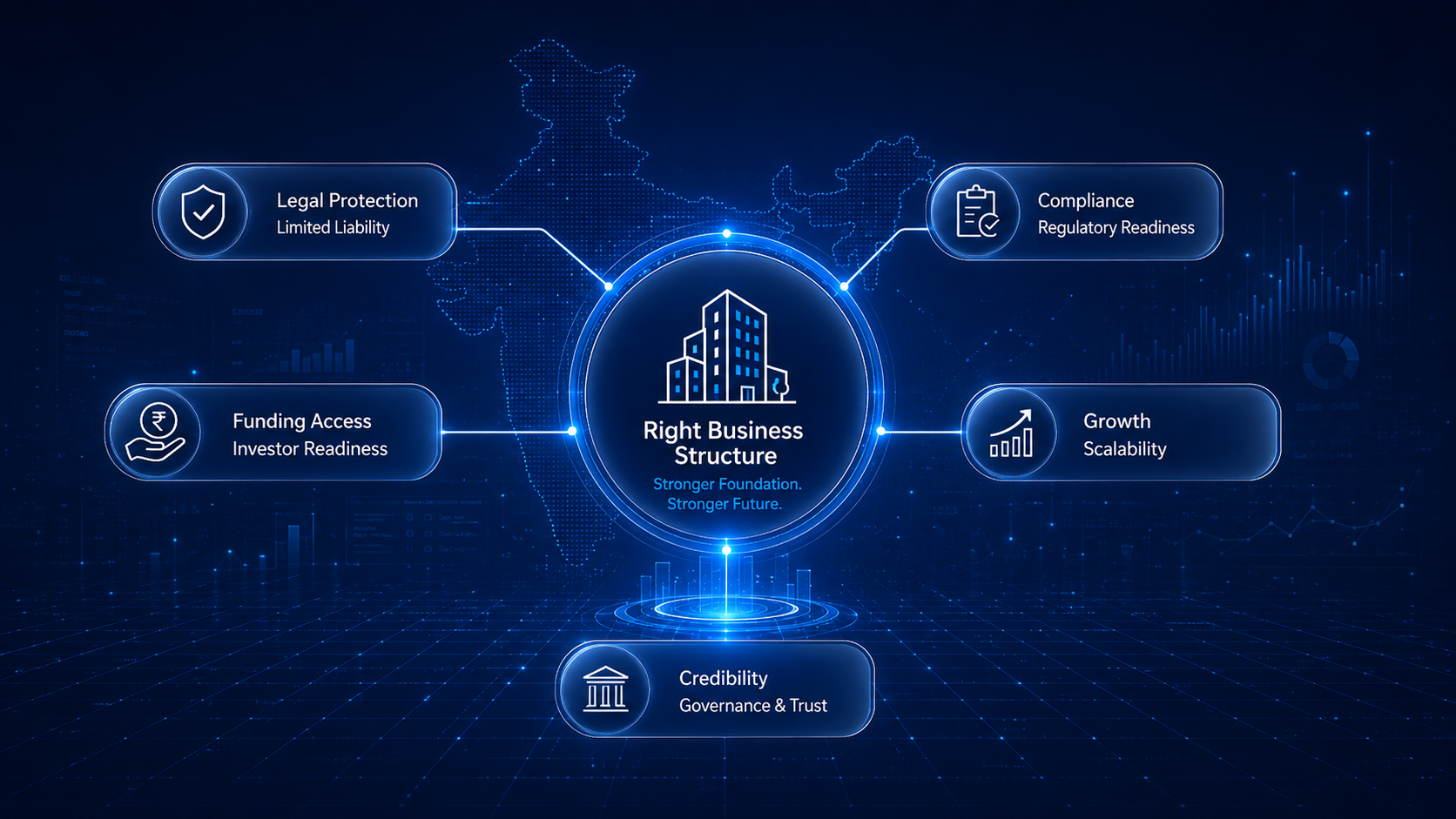
Different Business Structures Available for IT Companies in India
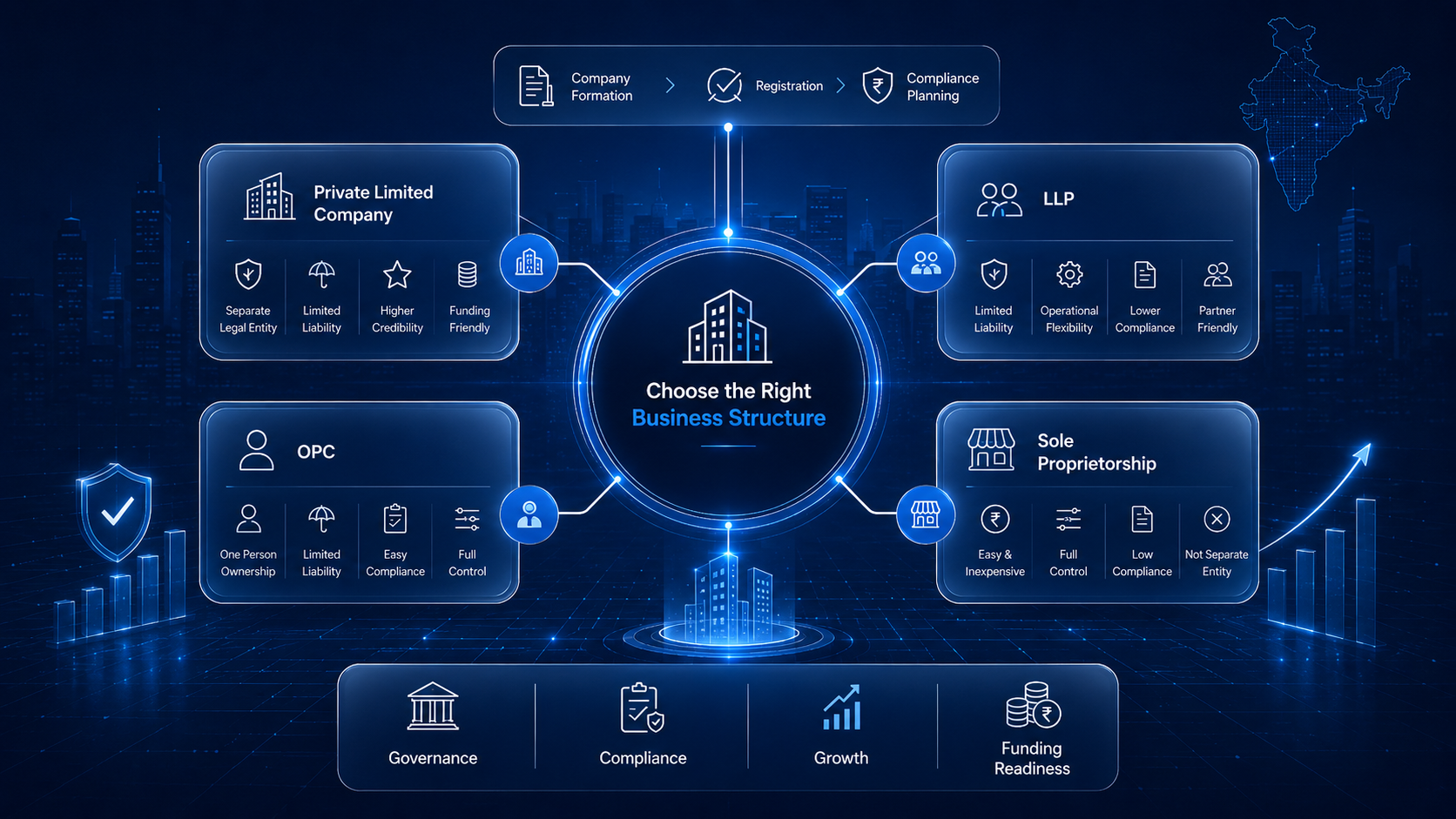
Entrepreneurs starting an IT companies in India generally choose from four major business structures:
- Sole Proprietorship
- One Person Company (OPC)
- Limited Liability Partnership (LLP)
- Private Limited Company
Each structure serves a different purpose and offers distinct advantages.
Let’s explore each option in detail.
Sole Proprietorship
A Sole Proprietorship is the simplest form of business structure available in India. It is owned and managed by a single individual.
Many freelance software developers, web designers, digital consultants, and independent IT professionals start their journey using this structure.
Since there is no separate legal entity, the owner and the business are considered the same for legal and tax purposes.
Who Should Consider a Sole Proprietorship?
This structure may be suitable for:
- Freelance developers
- Individual IT consultants
- Website designers
- Independent software professionals
- Small technology service providers
If you are testing a business idea or operating alone with limited revenue, a Sole Proprietorship can be a practical starting point.
Advantages of a Sole Proprietorship
The biggest advantage is simplicity.
There are minimal registration requirements, lower compliance obligations, and complete control remains with the owner.
You can start operations quickly and manage the business without extensive regulatory procedures.
Limitations of a Sole Proprietorship
Despite its simplicity, this structure has several limitations.
The most significant drawback is unlimited liability. If the business incurs debts or legal disputes, the owner’s personal assets may also be at risk.
It can also become difficult to attract investors, raise capital, or establish credibility with larger corporate clients.
As a result, Sole Proprietorships are generally better suited for individuals rather than scalable technology businesses.
Is Sole Proprietorship Suitable for an IT Company?
For freelancers and solo consultants, yes.
For startups planning growth, funding, or international expansion, it is usually not the ideal long-term choice.
One Person Company (OPC)
A One Person Company, commonly known as OPC, was introduced to help solo entrepreneurs operate through a corporate structure while retaining full ownership.
An OPC combines some benefits of a Private Limited Company with the simplicity of a single-owner business.
Who Should Choose an OPC?
An OPC may be suitable for:
- Solo SaaS founders
- Independent software entrepreneurs
- Tech professionals launching products
- Individual startup founders
If you want liability protection while maintaining complete ownership, an OPC can be an attractive option.
Benefits of an OPC
Unlike a Sole Proprietorship, an OPC is considered a separate legal entity.
This means the owner’s personal assets are generally protected from business liabilities.
It also improves business credibility and may help when dealing with enterprise clients or financial institutions.
Limitations of an OPC
While OPCs offer several advantages, they are not always ideal for high-growth startups.
Bringing in additional shareholders can be restrictive compared to a Private Limited Company.
If your long-term objective involves raising investor funding or building a large technology company, an OPC may eventually require restructuring.
Is OPC Good for Software Startups?
For solo founders launching a product or software solution, OPC can be a useful stepping stone.
However, startups planning aggressive growth often move toward a Private Limited Company structure.
Limited Liability Partnership (LLP)
The Limited Liability Partnership, or LLP, has become one of the most popular structures for service-based IT businesses in India.
It combines operational flexibility with liability protection and relatively lower compliance requirements.
For many software development agencies and technology consulting firms, LLP offers an effective balance between simplicity and professionalism.
Who Should Choose an LLP?
LLPs are commonly chosen by:
- Software development companies
- IT consulting firms
- Technology service providers
- Digital transformation agencies
- Web and mobile app development companies
If two or more partners are operating the business together and do not immediately require external funding, LLP can be a strong option.
Advantages of an LLP
One of the primary advantages is limited liability protection.
The personal assets of partners are generally protected from business liabilities.
LLPs also involve fewer compliance requirements compared to Private Limited Companies, making them easier and more cost-effective to manage.
Another benefit is flexibility in internal management and profit sharing.
Why Many IT Consulting Firms Prefer LLP
Most service-based IT companies generate revenue through client projects rather than investor funding.
Since these businesses often prioritize operational flexibility and lower compliance costs, LLP becomes an attractive structure.
For example, a digital marketing agency serving clients in India, the United States, the United Kingdom, or Australia can successfully operate as an LLP.
Limitations of LLP
The major limitation arises when raising external investment.
Although LLPs can accept investments under certain circumstances, most angel investors, venture capital firms, and institutional investors prefer investing in Private Limited Companies.
This can become a challenge for startups planning rapid scaling.
Private Limited Company
A Private Limited Company is widely considered the preferred business structure for technology startups and high-growth IT companies.
Many successful Indian startups began their journey as Private Limited Companies because this structure supports scalability, fundraising, and corporate governance.
Who Should Choose a Private Limited Company?
This structure is often best suited for:
- SaaS startups
- Product-based technology companies
- AI startups
- App development companies
- Technology platforms
- Venture-backed startups
- Businesses planning global expansion
Why Private Limited Companies Are Popular Among IT Startups
The biggest advantage is growth potential.
Private Limited Companies can issue shares, onboard investors, attract venture capital funding, and implement employee stock ownership plans.
These capabilities make them highly attractive for startups seeking long-term expansion.
Investor-Friendly Structure
When investors evaluate startup opportunities, they typically prefer Private Limited Companies because ownership can be clearly defined through equity shares.
This simplifies investment transactions and future fundraising rounds.
As a result, most startups aiming to secure angel investment, venture capital, or strategic funding choose this structure from the beginning.
Better Business Credibility
A Private Limited Company often creates a stronger impression among enterprise clients, international customers, and financial institutions.
Many large organizations prefer working with incorporated entities because they offer greater transparency and governance.
Limitations of a Private Limited Company
The primary drawback is higher compliance requirements.
Annual filings, statutory records, board-related procedures, and corporate compliance obligations are more extensive compared to LLPs.
However, many founders consider this a reasonable trade-off for the growth opportunities it provides.
Quick Comparison of Business Structures for IT Companies
|
Factor |
Sole Proprietorship | OPC | LLP |
Private Limited |
| Separate Legal Entity | No | Yes | Yes | Yes |
| Limited Liability | No | Yes | Yes | Yes |
| Compliance Burden | Low | Moderate | Moderate | Higher |
| Investor Friendly | No | Limited | Limited | Yes |
| Suitable for Startups | Limited | Moderate | Good | Excellent |
| Suitable for SaaS Companies | No | Moderate | Good | Excellent |
| Suitable for Fundraising | No | Limited | Limited | Excellent |
| Scalability | Low | Moderate | Good | Excellent |
Which Business Structure Is Best for IT Companies in India?
The answer depends on the type of technology business you are building.
A freelance software developer may find a Sole Proprietorship sufficient.
A software development agency may benefit from an LLP.
A SaaS startup planning to raise funding may be better positioned as a Private Limited Company.
In general:
- Freelancers often prefer Sole Proprietorship.
- Service-based IT firms frequently choose LLP.
- High-growth startups typically choose Private Limited Company.
- Solo entrepreneurs seeking liability protection may consider OPC.
The best structure is the one that aligns with your business goals, funding plans, and future growth strategy.
LLP vs Private Limited Company for IT Companies
There is no universal winner in this comparison.
The better structure depends entirely on your business model.
An LLP is often preferred by service-oriented businesses that want operational flexibility and lower compliance requirements.
A Private Limited Company is usually preferred by startups that want rapid growth, fundraising opportunities, and stronger investor appeal.
A simple way to think about it is:
- LLP is designed for business operations.
- Private Limited Company is designed for business growth.
This distinction becomes increasingly important as the company expands.
Understanding LLP for Software Development Companies
Many software development agencies start as LLPs because they primarily generate revenue from client projects.
These businesses are not necessarily looking for venture capital funding.
Instead, they focus on:
- Delivering software projects
- Providing IT consulting services
- Website development
- Mobile application development
- Dedicated development teams
- Outsourcing services
For such companies, LLP often provides sufficient legal protection without introducing excessive compliance requirements.
The structure is relatively simple to manage and allows partners to decide how profits will be shared.
For example, if two experienced software engineers start a custom software development company, LLP can be a practical choice.
Understanding Private Limited Company for Technology Startups
The situation changes when the company is developing a product rather than providing services.
Product-based businesses often require:
- Product development investment
- Marketing budgets
- Team expansion
- Technology infrastructure
- Future funding rounds
This is where a Private Limited Company becomes more attractive.
Investors prefer equity ownership structures because they make investment transactions easier and more transparent.
Whether you are building a SaaS platform, AI solution, fintech application, or enterprise software product, Private Limited Company is often the preferred structure.
This is one reason why many successful Indian startups chose this structure from the beginning.
Which Business Structure Is Better for SaaS Startups?
A common question founders ask is:
What is the best company structure for a SaaS startup in India?
For most SaaS businesses, the answer is usually a Private Limited Company.
SaaS companies often aim for rapid scaling.
Their revenue model depends on recurring subscriptions, customer acquisition, technology development, and market expansion.
As the business grows, founders may need:
- Angel investment
- Venture capital funding
- ESOP implementation
- Strategic partnerships
- International expansion
Private Limited Companies are better equipped to support these requirements.
An LLP can work for a small SaaS business initially, but many founders eventually convert to a Private Limited Company when growth accelerates.
Which Structure Is Best for IT Consulting Firms?
IT consulting businesses operate differently from startups.
Their primary focus is usually project execution and service delivery.
Revenue comes from expertise rather than a scalable technology product.
In many cases, LLP can be an excellent choice because it offers:
- Lower compliance requirements
- Limited liability protection
- Flexible management structure
- Cost-effective administration
For technology consulting firms, digital transformation agencies, cloud consulting companies, and software service providers, LLP often provides an ideal balance between professionalism and simplicity.
Which Business Structure Attracts Investors?
This is one of the most searched questions among startup founders.
The answer is straightforward.
Private Limited Companies are significantly more attractive to investors.
Investors evaluate several factors before funding a startup.
They want clarity regarding:
- Ownership structure
- Shareholding pattern
- Equity allocation
- Exit opportunities
- Future fundraising rounds
Private Limited Companies are specifically designed to accommodate these requirements.
They allow companies to issue shares, create investment agreements, and manage shareholder rights more efficiently.
As a result, angel investors, venture capital firms, and institutional investors generally prefer investing in Private Limited Companies.
Can LLP Receive Investment?
Technically, yes.
However, practical challenges often arise.
Most professional investors prefer equity-based investments.
Since LLPs do not operate through traditional shareholding structures, investment transactions can become more complicated.
This does not mean LLPs cannot grow.
Many successful service-based companies operate as LLPs for years.
The challenge mainly appears when external fundraising becomes a major priority.
Taxation Comparison for IT Companies in India
Taxation plays an important role when selecting a business structure.
Many founders assume one structure automatically saves more tax than another.
In reality, taxation depends on multiple factors, including revenue, profit margins, business activities, and future plans.
Instead of focusing only on tax rates, founders should evaluate the overall financial impact of the structure.
Taxation of Sole Proprietorship
In a Sole Proprietorship, business income is treated as the personal income of the owner.
The profits are taxed according to the individual’s applicable income tax slab.
This approach may work for smaller businesses, but as profits increase, tax planning becomes more important.
Taxation of LLP
An LLP is taxed separately from its partners.
Many founders appreciate the simplicity of LLP taxation.
The structure is often considered efficient for service-based businesses that generate stable profits.
Because profits belong to the LLP itself, taxation becomes more structured compared to Sole Proprietorship.
Taxation of Private Limited Company
A Private Limited Company is also taxed as a separate legal entity.
While taxation may appear more complex initially, Private Limited Companies often provide greater flexibility for growing businesses.
As revenue increases and operational complexity grows, structured financial management becomes increasingly valuable.
For startups planning long-term expansion, taxation is only one factor among many.
Fundraising potential, investor preference, scalability, and credibility are often equally important considerations.
GST Requirements for IT Companies
Regardless of business structure, many IT companies eventually need GST registration.
This is particularly relevant for businesses involved in:
- Software development services
- IT consulting
- SaaS subscriptions
- Export of software services
- Technology support services
GST compliance should be considered separately from business structure selection because registration requirements often depend on turnover, business activities, and client location.
Compliance Requirements: LLP vs Private Limited Company
One of the biggest differences between these two structures is compliance.
This is often where founders struggle to make a decision.
An LLP generally has fewer compliance requirements.
A Private Limited Company has more regulatory obligations.
However, compliance should not be viewed only as a burden.
Many investors see stronger governance and compliance systems as positive indicators of a company’s maturity.
Compliance Requirements for LLP
LLPs are often chosen because they offer a relatively straightforward compliance framework.
The administrative workload is generally lower compared to a Private Limited Company.
This allows founders to focus more on operations and client acquisition.
For service-oriented businesses, this can be a meaningful advantage.
Compliance Requirements for Private Limited Company
Private Limited Companies require more structured governance.
There are additional filing requirements, corporate records, and statutory responsibilities.
While this increases administrative work, it also creates a stronger corporate framework.
This framework becomes beneficial when:
- Investors enter the business
- Additional shareholders join
- Funding rounds occur
- Employee stock options are introduced
- Strategic acquisitions are considered
Many startups view compliance as an investment in future growth rather than simply a regulatory obligation.
Best Business Structure for Software Export Companies
India’s software export industry continues to grow rapidly.
Many IT companies serve clients in:
- United States
- United Kingdom
- Canada
- Australia
- Europe
- Middle East
For companies working with international clients, credibility becomes increasingly important.
Both LLP and Private Limited Company can support international business operations.
However, many founders prefer Private Limited Company when targeting enterprise clients and global expansion because it often creates stronger market perception.
Best Business Structure for AI Startups
Artificial intelligence startups usually require substantial investment in:
- Research
- Product development
- Infrastructure
- Talent acquisition
Because these businesses often seek external funding, Private Limited Company is generally the preferred structure.
Investors are more comfortable investing in companies with established shareholding mechanisms and corporate governance frameworks.
For AI startups with ambitious growth plans, Private Limited Company typically provides a stronger foundation.
Best Business Structure for App Development Companies
The answer depends on the business model.
If the company primarily develops applications for clients, LLP may work very well.
If the company is creating its own mobile application product and plans to scale aggressively, Private Limited Company often becomes the better option.
The distinction is not the technology itself.
The distinction is whether the company is service-based or product-based.
A Simple Decision Framework for Founders
When evaluating business structures, ask yourself the following questions:
Do you plan to raise investor funding?
Do you expect rapid growth?
Will you issue equity to future team members?
Do you intend to build a scalable technology product?
Will international expansion be part of your long-term strategy?
If the answer to most of these questions is yes, a Private Limited Company is often the stronger choice.
If your focus is client services, consulting, outsourcing, and steady growth without external investors, LLP may be more suitable.
The Reality Most Founders Discover
Many technology entrepreneurs initially choose a structure based on current needs.
The most successful founders choose based on future goals.
A software development agency with no plans for external investment may operate efficiently as an LLP for many years.
A SaaS startup expecting fundraising opportunities within the next few years often benefits from starting as a Private Limited Company from day one.
The key is aligning the business structure with the direction of the company rather than simply minimizing initial costs or compliance requirements.
Startup India Benefits for IT Companies
The Indian startup ecosystem has grown significantly over the last decade.
To encourage innovation and entrepreneurship, the Government of India launched the Startup India initiative.
For technology startups, this initiative can offer several advantages, including easier access to government support programs, startup recognition, networking opportunities, and potential tax-related benefits subject to eligibility criteria.
Many founders ask:
Can IT companies apply for Startup India recognition?
Yes. Many software companies, SaaS startups, AI startups, and technology businesses can apply if they meet the required eligibility criteria.
However, not every business automatically qualifies.
The company generally needs to demonstrate innovation, scalability, or the potential to generate employment and economic value.
For technology startups developing software products, digital platforms, AI solutions, automation tools, cloud-based systems, or innovative technology services, Startup India recognition can strengthen credibility and support future growth.
Which Business Structure Is Best for Startup India Registration?
While eligibility requirements can change over time, most recognized startups are commonly structured as Private Limited Companies.
This is one reason why many technology founders choose this structure when building scalable startups.
A Private Limited Company aligns well with the expectations of investors, accelerators, incubators, and startup ecosystems.
For founders building SaaS platforms, AI products, fintech applications, or enterprise software solutions, this structure often provides the strongest long-term foundation.
Common Mistakes IT Founders Make While Choosing a Business Structure
One of the biggest reasons businesses later restructure is because they selected a business structure based only on current circumstances.
A decision that appears cost-effective today may create obstacles in the future.
Let’s look at some common mistakes.
Choosing a Structure Only to Save Compliance Costs
Many founders focus entirely on reducing compliance expenses.
While lower compliance may seem attractive initially, it should not be the primary factor.
A company expecting rapid growth should prioritize scalability over short-term administrative savings.
The right structure should support future goals rather than simply reduce paperwork.
Ignoring Future Funding Requirements
This is one of the most common mistakes among startup founders.
Many businesses start as LLPs without considering future fundraising plans.
Later, when investors show interest, the company must undergo restructuring.
If fundraising is part of the long-term vision, it is often worth considering a Private Limited Company from the beginning.
Choosing a Sole Proprietorship for a Growing Technology Business
A Sole Proprietorship may work well for freelancers and independent consultants.
However, as revenue increases and larger clients enter the picture, the lack of limited liability and business scalability can become problematic.
For growing IT businesses, more structured entities generally provide stronger long-term support.
Not Thinking About International Expansion
Many software companies today serve clients across the world.
Even small development teams frequently work with customers in the United States, United Kingdom, Canada, Australia, and Europe.
Founders sometimes underestimate how important business credibility becomes when dealing with international clients.
A structure that supports professional growth and global operations can create long-term advantages.
When Should an LLP Convert into a Private Limited Company?
This is one of the most searched questions among technology entrepreneurs.
The answer depends on the stage of growth.
An LLP may function perfectly during the early years.
However, certain developments often signal that conversion should be considered.
You Are Planning to Raise Investment
Investors typically prefer Private Limited Companies.
If discussions with angel investors or venture capital firms are becoming serious, conversion may become necessary.
You Want to Issue ESOPs
Employee Stock Ownership Plans help startups attract and retain talent.
As companies grow, ESOPs become an important part of compensation strategies.
Private Limited Companies generally offer greater flexibility in this area.
You Are Building a Product-Based Business
Product companies often scale differently from service companies.
When revenue growth depends on customer acquisition and recurring subscriptions rather than project work, the need for a stronger corporate structure becomes more apparent.
You Are Expanding Globally
International partnerships, strategic investments, acquisitions, and global operations often become easier to manage within a Private Limited Company structure.
Step-by-Step Process to Register an IT Company in India
The registration process varies slightly depending on the chosen structure, but the general framework remains similar.
The first step is deciding which business structure aligns with your objectives.
Once that decision is made, founders typically move through the incorporation process, obtain necessary registrations, establish banking arrangements, and ensure ongoing compliance.
For most technology businesses, registration should not be viewed as a formality.
It is the foundation upon which future growth is built.
A properly structured company can avoid unnecessary legal, financial, and operational complications later.
Which Business Structure Is Best for Different Types of IT Businesses?
One of the easiest ways to make a decision is by examining your business model.
Different technology businesses have different needs.
Best Business Structure for Freelance Software Developers
For individuals working independently and serving clients directly, a Sole Proprietorship may be sufficient initially.
As the business grows, transitioning to a more structured entity can be considered.
Best Business Structure for IT Consulting Firms
Most IT consulting businesses benefit from LLP because it combines limited liability with relatively lower compliance requirements.
It is often a practical solution for service-focused companies.
Best Business Structure for Software Development Agencies
Software development agencies commonly choose LLP, particularly when growth is driven by client projects rather than investor funding.
However, agencies planning large-scale expansion may also consider Private Limited Company.
Best Business Structure for SaaS Startups
For most SaaS businesses, Private Limited Company is generally the preferred option.
The structure supports fundraising, equity allocation, team expansion, and long-term scalability.
Best Business Structure for AI Startups
AI startups often require significant investment and aggressive growth strategies.
Private Limited Company typically provides the strongest framework for these objectives.
Best Business Structure for Product-Based Technology Companies
Product-focused businesses generally benefit from a Private Limited Company because it supports future investment opportunities and strategic growth initiatives.
Expert Recommendation: Which Business Structure Is Best for IT Companies in India?
After evaluating thousands of business scenarios over the years, one pattern becomes clear.
The best structure depends less on the current size of the business and more on where the founder wants the business to go.
If your goal is to build a lifestyle business, consulting practice, or software service agency, LLP often provides an excellent balance between flexibility and compliance.
If your goal is to build a scalable technology company, attract investors, create intellectual property, and expand globally, Private Limited Company is usually the stronger choice.
There is no universally perfect structure.
The right structure is the one that aligns with your long-term vision.
Frequently Asked Questions (FAQs)
Q1. Which business structure is best for an IT company in India?
The answer depends on the business model. Service-based companies often prefer LLP, while startups planning fundraising and rapid growth generally choose Private Limited Company.
Q2. Is LLP better than Private Limited Company for software companies?
Not necessarily. LLP may be better for service-oriented businesses, while Private Limited Company is often better for scalable startups and technology products.
Q3. Can a software developer start as a Sole Proprietorship?
Yes. Many freelance software developers start this way. However, growing businesses often move to LLP or Private Limited Company for better liability protection and scalability.
Q4. Which structure is best for SaaS startups?
Private Limited Company is generally considered the preferred structure for SaaS startups because it supports fundraising, growth, and investor participation.
Q5. Which business structure attracts investors?
Private Limited Companies are usually the most attractive to investors because of their shareholding structure and corporate governance framework.
Q6. Can LLP receive investment?
Yes, but most professional investors prefer investing in Private Limited Companies.
Q7. Is LLP suitable for software development companies?
Yes. LLP is often a strong choice for software development agencies and IT consulting firms that focus on client projects rather than fundraising.
Q8. Can an LLP convert into a Private Limited Company?
Yes. Many growing businesses convert when they begin pursuing external funding or large-scale expansion.
Q9. Which structure has lower compliance requirements?
LLP generally has lower compliance requirements compared to a Private Limited Company.
Q10. Which structure is best for AI startups?
Most AI startups benefit from a Private Limited Company because it supports investment, scalability, and future growth.
Final Verdict: Best Business Structure for IT Companies in India
Choosing the right business structure is one of the most important decisions for any technology entrepreneur.
The decision affects taxation, compliance, investor readiness, business credibility, operational flexibility, and future scalability.
For freelancers and independent professionals, a Sole Proprietorship can be a practical starting point.
For service-based IT businesses, software development firms, and technology consulting companies, LLP often offers the right balance between simplicity and protection.
For SaaS startups, AI startups, product-based software companies, and businesses seeking investment, Private Limited Company is usually the most future-ready structure.
Quick Decision Matrix
| Business Type | Recommended Structure |
| Freelance Software Developer | Sole Proprietorship |
| IT Consultant | LLP |
| Software Development Agency | LLP |
| Web Development Company | LLP |
| App Development Company | LLP / Private Limited |
| SaaS Startup | Private Limited Company |
| AI Startup | Private Limited Company |
| Technology Product Company | Private Limited Company |
| Venture-Backed Startup | Private Limited Company |
| Global Software Business | Private Limited Company |
Conclusion
The best business structure for an IT company in India is not simply the one with the lowest compliance requirements or the lowest setup cost.
It is the structure that supports your future goals.
Before making a decision, evaluate where you want your company to be in the next five years. Consider funding plans, team growth, product development, international expansion, and long-term scalability.
A well-chosen business structure creates a stronger foundation for sustainable growth and helps your technology business move forward with confidence.
The post Best Business Structure for IT Companies in India: A Complete Guide for Startups, Software Companies, and Tech Entrepreneurs first appeared on AmarParul Ventures (OPC) Pvt. Ltd.
]]>The post How to Start a Business Legally in India first appeared on AmarParul Ventures (OPC) Pvt. Ltd.
]]>Whether you are launching a startup, opening a small business, starting an online company, or working as a freelancer, understanding the legal process is important for long-term success. Proper registration not only gives your business a legal identity but also helps build trust with customers, investors, and financial institutions.
If you are planning to start a business legally in India, this guide explains everything you need to know from choosing the right business structure to GST registration, licenses, compliance requirements, and professional support.
Businesses that want proper legal guidance often prefer working with experienced company registration services to avoid delays and compliance issues during the registration process.
Why Starting a Business Legally in India Is Important
Many small businesses begin informally, especially home businesses, freelancers, and local startups. However, operating without proper registration can create difficulties as the business grows.
A legally registered business offers several advantages:
- Builds trust among customers and vendors
- Helps open a business bank account
- Makes GST registration easier
- Improves loan and funding eligibility
- Protects the business from legal penalties
- Creates a professional business image
- Supports long-term business growth
Businesses with proper legal registration also find it easier to apply for government schemes, partnerships, and financial support.
Professional business advisory services can help entrepreneurs choose the right structure and avoid common legal mistakes during the early stages of business setup.

Step 1: Choose the Right Business Structure
One of the most important decisions while starting a business legally in India is selecting the right business structure. The structure affects taxation, compliance, ownership, liability, and future expansion opportunities.
Sole Proprietorship
A sole proprietorship is suitable for:
- Small businesses
- Freelancers
- Local shops
- Home businesses
It is one of the easiest and most affordable business structures in India. The owner and the business are treated as the same legal entity.
Benefits:-
- Easy to start
- Low compliance
- Simple taxation process
Limitations:-
- Unlimited personal liability
- Difficult to raise investment
- Limited scalability
Partnership Firm
A partnership firm is suitable when two or more people want to run a business together.
Benefits:-
- Shared responsibilities
- Easy setup process
- Flexible operations
Limitations:-
- Shared liabilities
- Possible partner disputes
- Limited legal protection
Limited Liability Partnership (LLP)
An LLP combines the flexibility of a partnership with liability protection.
Benefits:-
- Limited liability protection
- Separate legal identity
- Better business credibility
Best For:-
- Professional firms
- Consulting businesses
- Growing startups
Private Limited Company
A private limited company is one of the most preferred structures for startups and growing businesses.
Benefits:-
- Strong legal identity
- Investor-friendly structure
- Better funding opportunities
- Limited liability protection
Limitations:-
- Higher compliance requirements
- Regular ROC filings
- Structured legal process
Entrepreneurs planning future expansion often choose professional company incorporation services to ensure the registration process is completed correctly.
One Person Company (OPC)
An OPC is designed for solo entrepreneurs who want the benefits of a corporate structure without multiple shareholders.
Benefits:-
- Limited liability
- Separate legal identity
- Better professional image
Suitable For:-
- Solo founders
- Consultants
- Individual startups
Comparison of Business Structures in India
| Business Type | Liability | Compliance | Best For |
| Sole Proprietorship | Unlimited | Low | Small businesses |
| Partnership Firm | Shared | Moderate | Family or partner businesses |
| LLP | Limited | Moderate | Service businesses |
| Private Limited Company | Limited | Higher | Startups and growing businesses |
| OPC | Limited | Moderate | Solo entrepreneurs |
Step 2: Decide Your Business Name
Your business name plays an important role in branding and legal identity.
Before finalizing a name:
- Check MCA name availability
- Verify trademark conflicts
- Check domain availability
- Ensure the name matches your business activity
Choosing a unique and professional business name improves credibility and helps create a strong market presence.
Businesses planning long-term brand growth should also consider trademark protection during the early stages.
Step 3: Prepare the Required Documents
The documentation process is an important part of legal business registration in India.
Common documents required include:
- PAN card
- Aadhaar card
- Passport-size photographs
- Address proof
- Business address proof
- Utility bill
- NOC from property owner (if applicable)
For private limited companies and LLPs, additional documents may also be required.
Professional startup registration services can simplify the documentation and approval process significantly.
Step 4: Register Your Business Legally
Once the structure and documents are ready, the next step is completing the registration process.
The registration process usually includes:
- Digital Signature Certificate (DSC)
- Director Identification Number (DIN)
- Name approval
- Incorporation filing
- PAN and TAN generation
- Certificate of Incorporation
Today, most business registration processes in India can be completed online through the MCA portal.
However, errors in documentation or filing often delay approvals. This is why many startups prefer experienced legal business registration support to complete the process smoothly.
Step 5: Apply for GST Registration
GST registration is one of the most important legal requirements for businesses in India.
You may need GST registration if:
- Your turnover crosses the prescribed limit
- You sell products or services across states
- You run an online business
- You work with GST-registered companies
Benefits of GST Registration
- Legal tax compliance
- Input tax credit benefits
- Improved business credibility
- Easier B2B operations
Ignoring GST requirements can lead to penalties and compliance problems later.
Businesses often work with professional taxation advisory services to manage GST registration and filing properly.
Step 6: Obtain Necessary Licenses and Permits
Different businesses may require different licenses depending on the industry and operations.
Some common licenses include:
- MSME Registration
- Shop and Establishment License
- FSSAI License
- Professional Tax Registration
- Import Export Code (IEC)
- Trade License
For example:
- Food businesses require FSSAI approval
- Export businesses require IEC registration
- Retail stores may require local trade licenses
Understanding licensing requirements early helps avoid legal issues later.
Step 7: Open a Business Bank Account
A separate business bank account is important for maintaining financial transparency.
Using a personal account for business transactions can create accounting and taxation complications.
Benefits of a Business Account
- Better bookkeeping
- Easier tax filing
- Professional transactions
- Improved financial tracking
Most banks require:
- PAN card
- Business registration proof
- GST certificate (if applicable)
- Address proof
Step 8: Maintain Proper Accounting and Compliance
Many businesses focus only on registration and ignore compliance after setup. This creates serious issues later.
Legal business compliance includes:
- GST filing
- Income tax filing
- ROC filing
- TDS compliance
- Accounting records
- Annual returns
Proper accounting helps businesses:
- Track financial performance
- Avoid penalties
- Improve tax planning
- Maintain legal compliance
Growing businesses usually prefer professional accounting and compliance services to manage regular filings and financial records efficiently.
Common Legal Mistakes New Businesses Make
Many startups face legal and financial problems because of avoidable mistakes.
Some common mistakes include:
Choosing the Wrong Business Structure
Selecting the wrong structure can increase taxation and compliance burdens later.
Delaying GST Registration
Late GST registration may result in penalties and loss of input tax benefits.
Ignoring Compliance Deadlines
Missing filing deadlines can create unnecessary legal notices and penalties.
Mixing Personal and Business Finances
This creates accounting confusion and affects business transparency.
Ignoring Trademark Protection
Without trademark registration, businesses may face future branding disputes.
Professional startup compliance services can help businesses avoid these issues from the beginning.
How Much Does It Cost to Start a Business Legally in India?
The cost depends on the business structure and registration requirements.
Approximate Costs
| Registration Type | Estimated Cost |
| Sole Proprietorship | Low |
| Partnership Firm | Moderate |
| LLP Registration | Moderate |
| Private Limited Company | Higher |
| GST Registration | Usually affordable |
Additional costs may include:
- Professional fees
- License fees
- Compliance costs
- Trademark registration
- Accounting expenses
Businesses planning funding or loan applications may also require proper financial documents and project report preparation services for better financial planning.
How Long Does Business Registration Take in India?
The timeline depends on the business structure and document readiness.
Estimated Timelines
| Process | Estimated Time |
| Sole Proprietorship | Few days |
| Partnership Firm | 5–10 days |
| LLP Registration | 10–15 days |
| Private Limited Company | 10–20 days |
| GST Registration | 7–10 days |
Proper documentation and professional support can help speed up the approval process.
Why Professional CA Guidance Matters for New Businesses
Starting a business legally involves more than registration alone. Entrepreneurs must also understand taxation, compliance, documentation, accounting, and financial planning.
Professional support helps businesses:
- Avoid legal mistakes
- Choose the right structure
- Complete registrations correctly
- Maintain compliance
- Improve tax planning
- Build long-term financial stability
Experienced CA services for businesses can simplify the entire process and help startups focus more on growth instead of paperwork.
Businesses looking for professional assistance can also contact our CA experts for registration, taxation, and compliance support.
Final Thoughts
Starting a business legally in India is one of the smartest decisions for long-term growth and stability. A properly registered business creates trust, improves financial opportunities, and protects entrepreneurs from future legal problems.
From choosing the right business structure to GST registration, accounting, compliance, and taxation, every step plays an important role in building a strong business foundation.
Whether you are launching a startup, opening a small business, or expanding your operations, working with experienced professionals can make the entire process smoother and more efficient.
Reliable business registration and compliance solutions can help businesses stay legally secure while focusing on growth and success.
Frequently Asked Questions
Can I start a business without registration in India?
Yes, some small businesses start informally, but legal registration is recommended for taxation, banking, compliance, and long-term growth.
Which business structure is best for startups?
Private Limited Company and LLP structures are commonly preferred for startups because they offer better legal protection and scalability.
Is GST mandatory for every business?
No. GST registration depends on turnover limits and business activity. However, many businesses voluntarily register for operational benefits.
Can I register a company online in India?
Yes. Most business registrations in India can now be completed online through the MCA portal.
What licenses are required for small businesses?
The requirement depends on the industry. Common licenses include MSME registration, Shop and Establishment License, GST registration, and FSSAI approval.
Why is accounting important for new businesses?
Proper accounting helps businesses manage taxes, maintain compliance, track profits, and avoid financial problems in the future.
The post How to Start a Business Legally in India first appeared on AmarParul Ventures (OPC) Pvt. Ltd.
]]>The post Common Mistakes Founders Make During Company Registration in India first appeared on AmarParul Ventures (OPC) Pvt. Ltd.
]]>This is where problems usually begin.
The decisions made during company registration can directly affect taxation, compliance, ownership structure, future funding, banking, and long-term business growth. A small mistake at the beginning may create financial or legal complications later that are expensive and time-consuming to fix.
Over the years, many startups and small businesses have faced issues not because their business idea was weak, but because the foundation of the business was not planned properly during incorporation. From choosing the wrong structure to ignoring compliance requirements, these mistakes are more common than most founders realize.
Understanding the complete startup registration process and getting proper business registration guidance early can help founders avoid unnecessary penalties, delays, and operational challenges in the future.
In this article, we will discuss the most common mistakes founders make during company registration in India and how businesses can avoid them from the beginning.
Why Company Registration Is More Than Just Paperwork
Many founders believe that company registration is only about getting an incorporation certificate from the Ministry of Corporate Affairs (MCA). In reality, it is much more than that.
Your business structure decides:
- how your company will be taxed
- how compliance will be managed
- how ownership will work
- whether investors will be comfortable investing
- how much personal liability founders will carry
A properly planned registration process creates a strong legal and financial base for the business. On the other hand, poor planning during incorporation often leads to compliance pressure, tax confusion, operational delays, and restructuring costs later.
This is why many startups today prefer taking professional support during the company registration process instead of treating incorporation as a low-priority task.

Mistake #1: Choosing the Wrong Business Structure
One of the biggest startup registration mistakes founders make is selecting the wrong business structure without understanding its long-term impact.
Many businesses choose a Private Limited Company simply because it sounds professional or because someone suggested it online. Others choose an LLP only because the registration cost is lower. In reality, the right structure depends on the nature of the business, future goals, funding plans, taxation, and operational requirements.
For example, a small consulting business with limited operational complexity may prefer an LLP because compliance requirements are comparatively lower. But if a startup plans to raise investment in the future, a Private Limited Company is usually more suitable because investors generally prefer that structure.
Choosing the wrong business structure in India can create problems such as:
- higher compliance costs
- unnecessary annual filing obligations
- difficulty during funding rounds
- taxation inefficiencies
- ownership complications
Many founders realize these issues only after the business starts growing, and restructuring later becomes expensive.
Getting proper business structure advisory at the beginning can help businesses choose a structure that supports long-term growth instead of creating future limitations.
Mistake #2: Not Planning Founder Roles and Shareholding Properly
In the early stage of a startup, founders are usually focused on launching quickly. Because of this, shareholding decisions are often made emotionally instead of strategically.
Equal ownership may sound fair initially, but without proper planning, it can create serious disputes later.
Many startups fail because there is no clarity regarding:
- founder responsibilities
- profit sharing
- decision-making authority
- operational control
- exit terms
This becomes even more complicated when the business starts generating revenue or when external investors become involved.
A proper founder agreement helps avoid confusion and creates transparency among all founders. It also improves investor confidence because investors prefer businesses with structured ownership and governance.
Ignoring founder planning is one of the most common company incorporation mistakes seen in startups across India.
Professional startup advisory services can help founders create a practical ownership structure that supports smooth business operations and future scalability.
Mistake #3: Choosing a Company Name Without Proper Legal Checks
Many founders spend time creating a brand name, purchasing a domain, designing logos, and building social media pages before checking whether the name is legally available.
This often leads to major problems later.
MCA approval does not automatically provide trademark protection. A company name may get approved during incorporation, but if a similar trademark already exists, the business may still face legal issues in the future.
Common company name approval mistakes include:
- selecting names similar to existing businesses
- ignoring trademark searches
- choosing generic names
- using restricted words without approval
- buying domains before legal verification
If the company name gets rejected during registration, the entire incorporation process may get delayed. In some cases, businesses are forced to rebrand after launch, which increases marketing and operational costs.
Before finalizing a name, founders should properly verify:
- MCA availability
- trademark availability
- domain availability
- long-term branding suitability
This simple step can prevent major legal and branding issues later.
Mistake #4: Submitting Incorrect or Incomplete Documentation
Documentation errors are another major reason for delays during company registration in India.
Even small mistakes can result in rejection or resubmission from the MCA portal.
Some of the most common document mistakes include:
- PAN and Aadhaar mismatch
- spelling errors
- invalid address proof
- outdated utility bills
- incorrect business activity details
- poor document scans
- DSC or DIN application errors
Many founders underestimate how strict MCA verification systems have become. A simple mismatch in signatures, addresses, or names can slow down the registration process significantly.
Founders should also ensure that all incorporation documents are prepared carefully before SPICe+ filing.
Taking proper registration filing support helps reduce documentation errors and avoids unnecessary delays during incorporation.
Mistake #5: Ignoring GST, Tax, and Other Mandatory Registrations
Many founders believe their work is complete once the company incorporation certificate is received. However, registration is only one part of the legal setup process.
Depending on the business type, startups may also require:
- GST registration
- MSME registration
- Professional Tax registration
- Shops and Establishment registration
- Import Export Code
- PF and ESIC registration
One of the most common GST registration mistakes is delaying GST application even when the business becomes eligible under law. This can create invoicing problems, vendor payment delays, and tax complications later.
Improper tax planning during the startup stage may also affect profitability and compliance management.
Businesses that understand startup taxation requirements early usually manage growth more smoothly compared to those that ignore compliance until notices or penalties arrive.
Getting proper startup taxation support helps businesses stay compliant while planning taxation more efficiently from the beginning.
Mistake #6: Ignoring Post-Registration Compliance Requirements
This is one of the biggest mistakes startups make after company registration.
Many founders believe compliance starts only when the company begins generating revenue. But in India, even companies with zero turnover may still need to complete mandatory ROC and MCA filings.
Some important post-incorporation compliance requirements include:
- annual ROC filing
- AOC-4 filing
- MGT-7 filing
- DIR-3 KYC
- INC-20A compliance
- maintaining statutory registers
When these filings are ignored, penalties start increasing continuously. In some cases, directors may even face disqualification.
Many startups eventually end up paying penalties much higher than their original company registration cost simply because compliance was ignored in the early stage.
Proper startup compliance support helps businesses stay updated with annual filing requirements and reduces the risk of notices, penalties, and operational issues later.
Mistake #7: Using Personal Bank Accounts for Business Transactions
This is a very common issue among early-stage businesses and startups.
To simplify operations initially, many founders start accepting payments in personal bank accounts instead of opening a dedicated current account for the company.
Although this may look convenient in the beginning, it creates serious accounting and taxation problems later.
Mixing personal and business transactions creates difficulties in:
- bookkeeping
- auditing
- GST reconciliation
- tax filing
- cash flow tracking
It also affects transparency during investor due diligence and financial reviews.
Maintaining proper accounting records from the beginning is important for every business, even if operations are still small.
Professional accounting and compliance services can help startups maintain organized financial records and avoid confusion during taxation or audits.
Mistake #8: Not Planning for Future Funding or Business Growth
Many founders register their company only for current operations without thinking about future growth.
However, investors usually evaluate:
- company structure
- compliance records
- shareholding pattern
- taxation history
- legal documentation
before investing in any startup.
Improper planning during registration may create funding complications later.
For example:
- unclear shareholding structures
- missing founder agreements
- incomplete compliance records
- irregular accounting
- improper tax filings
can negatively affect investor confidence.
Businesses that maintain clean compliance records and proper financial documentation usually attract better investment opportunities.
Proper financial advisory support helps startups prepare for long-term business growth while maintaining operational and legal stability.
Mistake #9: Trying to Save Money by Using Cheap Registration Services
Many founders choose extremely low-cost registration services without understanding what is actually included.
In many cases, these services only complete basic incorporation filing without offering proper guidance regarding:
- taxation
- compliance
- annual filings
- business structuring
- documentation planning
As a result, founders later face:
- filing mistakes
- compliance notices
- delayed registrations
- incorrect business setup
- hidden compliance costs
Cheap incorporation services may look affordable initially, but the long-term cost of correcting mistakes is usually much higher.
Choosing professional company registration guidance helps businesses build a stronger foundation from the beginning and reduces future operational risks.
Practical Checklist Before Registering Your Company
Before starting the company registration process in India, founders should carefully review a few important areas.
Make sure you:
- choose the correct business structure
- verify company name availability
- check trademark availability
- finalize founder roles clearly
- prepare proper documentation
- understand annual compliance obligations
- plan taxation properly
- open a dedicated business bank account
- maintain proper accounting records
- understand future funding requirements
Following a proper startup registration checklist can help founders avoid unnecessary legal and compliance issues later.
Businesses that take time to plan properly during incorporation usually experience smoother operations and better long-term stability.
Final Thoughts
Starting a business involves much more than registering a company name. The decisions made during company registration in India can affect taxation, compliance, funding opportunities, legal protection, and overall business growth for years.
Most company registration mistakes happen because founders focus only on launching quickly without understanding the long-term impact of early decisions.
Whether it is choosing the wrong business structure, ignoring compliance requirements, delaying GST registration, or managing finances improperly, these issues can create serious operational challenges later.
A properly planned incorporation process helps businesses stay legally compliant, financially organized, and better prepared for growth.
Getting professional guidance during the early stages can help founders avoid unnecessary complications and build a stronger foundation for sustainable business success.
The post Common Mistakes Founders Make During Company Registration in India first appeared on AmarParul Ventures (OPC) Pvt. Ltd.
]]>The post Pvt Ltd vs LLP: Which Business Structure is Better for Startups in India? first appeared on AmarParul Ventures (OPC) Pvt. Ltd.
]]>Should you register your business as a Private Limited Company or an LLP?
At first, both structures may look similar because both offer limited liability protection and legal recognition. But when a business starts growing, the difference becomes much more important. Funding opportunities, taxation, compliance, scalability, investor interest, and long-term business goals all depend heavily on the structure you choose.
Many founders select a structure only because someone suggested it, or because it looks cheaper initially. Later, they face challenges with compliance, investor onboarding, ownership transfer, or taxation. That is why choosing the right structure from the beginning matters.
In this guide, we will understand the real difference between Pvt Ltd vs LLP in simple words, so startups and business owners can make a practical decision based on their business goals.
Understanding Private Limited Company
A Private Limited Company is one of the most preferred business structures for startups in India. It is registered under the Companies Act and operates as a separate legal entity from its owners.
In simple terms, the company and the founders are treated separately in the eyes of law. This helps protect the personal assets of directors and shareholders.
A Private Limited Company can have shareholders, directors, and investors. Ownership is divided into shares, which makes fundraising and ownership transfer easier later.
Most scalable startups prefer Private Limited Company registration because investors and venture capital firms are generally more comfortable investing in this structure. Businesses planning long-term expansion, funding, or aggressive growth usually consider this model more suitable.
Startups looking for structured and professional company registration services often choose this route because it creates stronger credibility in the market.
You can explore professional company registration services if you are planning to register a startup or growing business.
Understanding LLP (Limited Liability Partnership)
An LLP, also known as Limited Liability Partnership, combines the flexibility of a partnership with the benefit of limited liability.
This structure is governed under the LLP Act. Unlike a Private Limited Company, LLP works through partners instead of shareholders.
One of the biggest reasons many small businesses choose LLP is simpler compliance. Compared to a Private Limited Company, LLP usually involves lower annual compliance and easier operational management.
LLP is commonly preferred by:
- consultants
- freelancers
- small agencies
- professional firms
- family-run businesses
For businesses that do not plan to raise external funding immediately, LLP can be a practical option.
Many startups initially choose LLP registration guidance because of lower maintenance requirements and operational flexibility.
Pvt Ltd vs LLP: Quick Comparison
| Factor | Pvt Ltd | LLP |
| Legal Structure | Separate company entity | Partnership structure |
| Ownership | Shareholders | Partners |
| Investor Preference | Very high | Limited |
| Compliance | Higher | Lower |
| Funding Capability | Strong | Limited |
| Scalability | Better for expansion | Better for small businesses |
| Annual Filing | Mandatory | Mandatory but simpler |
| Transfer of Ownership | Easier | Comparatively limited |
| Best Suitable For | Startups & scalable businesses | Consultants & small firms |
This quick comparison helps understand why the Pvt Ltd vs LLP debate depends mostly on future business plans rather than only registration cost.
Difference Between LLP and Pvt Ltd Explained in Detail
Ownership Structure
One of the biggest differences between LLP and Pvt Ltd is ownership structure.
In a Private Limited Company, ownership is divided through shares. This makes adding investors or transferring ownership easier in future.
In LLP, ownership works through partnership agreements. Partners hold operational rights instead of shares.
If your startup may onboard investors or co-founders later, a Private Limited structure generally offers more flexibility.
Funding & Investor Opportunities
This is one of the most important factors for startups.
If you plan to raise funding in the future, Private Limited Company usually becomes the stronger choice.
Most angel investors, venture capital firms, and institutional investors prefer Private Limited Companies because:
- ownership structure is clear
- equity distribution is easier
- shares can be issued
- ESOPs can be created for employees
On the other hand, LLP has limitations in equity-based fundraising. While LLP can receive investment in some forms, most professional investors prefer structured equity ownership available in Private Limited Companies.
This is why many founders who initially register LLP later convert it into a Private Limited Company once growth starts.
Businesses planning funding or expansion often take professional startup finance advisory to understand long-term implications before selecting a structure.
Compliance Requirements
Compliance is another major difference between LLP vs Pvt Ltd.
A Private Limited Company usually has:
- ROC filings
- annual returns
- board-related compliance
- statutory documentation
- stricter reporting obligations
An LLP generally has fewer compliance requirements compared to a Private Limited Company.
For many small business owners, lower compliance becomes a strong reason for selecting LLP.
However, founders should not choose a structure only because of lower compliance. Long-term business goals matter more than short-term convenience.
Growing startups usually require proper business compliance services to avoid future legal and operational issues.
Taxation Difference Between LLP and Pvt Ltd
Taxation is another area where founders often get confused.
Both LLP and Private Limited Company have different taxation structures, and the better option depends on business income, profit distribution, and future plans.
In LLP, profits can usually be withdrawn by partners more flexibly. Many professional firms and consulting businesses prefer LLP for this reason.
In Private Limited Company, taxation works differently because the company operates as a separate legal entity. Dividend distribution and corporate taxation also become relevant in certain situations.
There is no universal answer to which saves more tax. The better structure depends on:
- business type
- profit level
- growth plans
- investor involvement
- future expansion
This is why startups often take professional taxation advisory services before making a final decision.
Cost of Maintenance
Many founders compare LLP vs Pvt Ltd mainly based on registration cost. But focusing only on initial registration fees can be misleading.
A Private Limited Company generally has:
- higher compliance costs
- structured filing requirements
- audit-related expenses
- professional maintenance requirements
LLP usually has lower annual maintenance costs, especially for small businesses with limited operations.
However, businesses planning aggressive growth may still prefer Private Limited Company because of better scalability and investor confidence.
Choosing only the cheaper option without considering future business plans can create problems later.
Scalability & Long-Term Growth
Scalability is where Private Limited Companies usually gain a major advantage.
If your startup plans:
- external funding
- nationwide expansion
- enterprise partnerships
- employee hiring
- long-term brand building
then Private Limited Company generally creates stronger growth opportunities.
Many enterprise clients and investors also see Private Limited Companies as more structured and scalable.
On the other hand, LLP works well for businesses focused on stable operations rather than aggressive expansion.
Businesses planning long-term expansion often take business growth advisory to choose the right structure based on future goals.
Which is Better for Startups in India?
There is no single answer that fits every startup.
The right structure depends on what kind of business you are building.
Private Limited Company is Usually Better If:
- you plan to raise funding
- you want rapid business growth
- your startup may onboard investors
- you want better scalability
- you are building a tech startup or SaaS business
- you may offer ESOPs in future
- you want stronger market credibility
For many startups, Pvt Ltd vs LLP becomes less about compliance and more about future scalability.
LLP is Usually Better If:
- you run a consulting business
- you are a freelancer or professional service provider
- you prefer simpler compliance
- you do not plan investor funding
- your operations are small or stable
- you want operational flexibility
LLP works especially well for businesses that want simpler management without aggressive fundraising plans.
Real-Life Practical Scenarios
Scenario 1: Tech Startup Seeking Funding
A technology startup planning app development, software scaling, or investor funding will usually benefit more from a Private Limited Company.
Investors generally feel more comfortable with shareholding structures available in Pvt Ltd companies.
Scenario 2: Small Consulting Firm
A small consulting or advisory firm with two or three partners may find LLP more practical because of lower compliance and operational flexibility.
Scenario 3: Digital Marketing Agency
A digital marketing agency planning long-term expansion, team growth, and investor onboarding may eventually prefer Private Limited Company.
But a small agency focused on stable client servicing may comfortably operate as LLP.
Scenario 4: Ecommerce Startup
Ecommerce businesses often require scaling, vendor partnerships, funding, and operational expansion. Because of this, many ecommerce founders choose Private Limited structure from the beginning.
Common Mistakes Founders Make While Choosing Business Structure
Many startups make decisions too quickly during registration.
Some founders choose LLP only because it looks cheaper initially. Others choose Private Limited Company without understanding compliance responsibilities.
Common mistakes include:
- ignoring future funding plans
- not considering long-term scalability
- choosing based only on registration cost
- copying competitors blindly
- ignoring compliance requirements
- taking decisions without professional guidance
The right business structure should support future business goals, not only present convenience.
Can LLP Be Converted Into Pvt Ltd Later?
Yes, LLP can be converted into a Private Limited Company later.
In fact, many startups initially register as LLP and later shift to Private Limited Company when:
- funding opportunities increase
- business expansion starts
- investors enter
- scalability becomes important
However, conversion involves legal and compliance procedures. That is why many founders prefer planning correctly from the beginning.
Questions Founders Should Ask Before Choosing LLP or Pvt Ltd
Before finalizing your structure, ask yourself:
- Do I plan to raise funding later?
- Will I onboard investors?
- How fast do I want to scale?
- Do I prefer lower compliance?
- Is my business investor-focused or service-focused?
- Will I expand nationally or internationally?
- Do I want a flexible partnership structure?
These questions usually help remove confusion around Pvt Ltd vs LLP more clearly than simply comparing registration costs.
If you are still unsure, taking expert CA guidance can help you make a better long-term decision.
Final Verdict: Which One Should You Choose?
When comparing Pvt Ltd vs LLP, the right choice depends entirely on your business vision.
If your startup is focused on:
- funding
- scaling
- expansion
- investor onboarding
- long-term growth
then Private Limited Company usually becomes the stronger option.
But if your business is more focused on:
- professional services
- consulting
- stable operations
- lower compliance
- operational flexibility
then LLP can be a practical and efficient structure.
The important thing is not choosing the “cheaper” option. The important thing is choosing the structure that supports your future business goals.
Many founders realize later that changing business structure becomes more complicated than planning correctly from the beginning.
Professional business structure consultation can help startups choose the right registration model based on growth plans, taxation, compliance, and future scalability.
Frequently Asked Questions
Which is better LLP or Pvt Ltd for startups?
For scalable startups planning funding and expansion, Private Limited Company is generally considered better. LLP works well for smaller service-focused businesses.
Can LLP raise funding in India?
LLP can receive funding in certain ways, but most investors prefer Private Limited Companies because of structured shareholding and equity ownership.
Is LLP cheaper than Pvt Ltd?
Yes, LLP usually has lower compliance and maintenance costs compared to a Private Limited Company.
Why do investors prefer Pvt Ltd companies?
Investors prefer Private Limited Companies because they allow easier equity distribution, ownership transfer, and structured fundraising.
Which has less compliance LLP or Pvt Ltd?
LLP generally has simpler compliance requirements compared to Private Limited Company.
Can LLP convert into Pvt Ltd later?
Yes, LLP can be converted into a Private Limited Company through legal conversion procedures.
Is Pvt Ltd mandatory for startups?
No, it is not mandatory. The best structure depends on the startup’s goals, funding plans, and operational needs.
Which structure is better for tax savings?
The better taxation structure depends on profit levels, business type, and future financial planning. There is no one-size-fits-all answer.
Conclusion
Choosing between Pvt Ltd vs LLP is one of the first major decisions for any startup in India. The right structure can support future growth, funding opportunities, taxation planning, operational flexibility, and business credibility.
Instead of selecting a structure only based on short-term cost, founders should think about long-term business direction.
A structure that works perfectly for a consulting firm may not work well for a technology startup planning aggressive expansion.
Understanding the real difference between LLP and Private Limited Company helps businesses avoid future complications and make smarter decisions from the beginning.
At Amarparul Ventures, startups and businesses can get professional guidance for registration, compliance, taxation, and long-term business planning based on their business goals and growth strategy.
The post Pvt Ltd vs LLP: Which Business Structure is Better for Startups in India? first appeared on AmarParul Ventures (OPC) Pvt. Ltd.
]]>