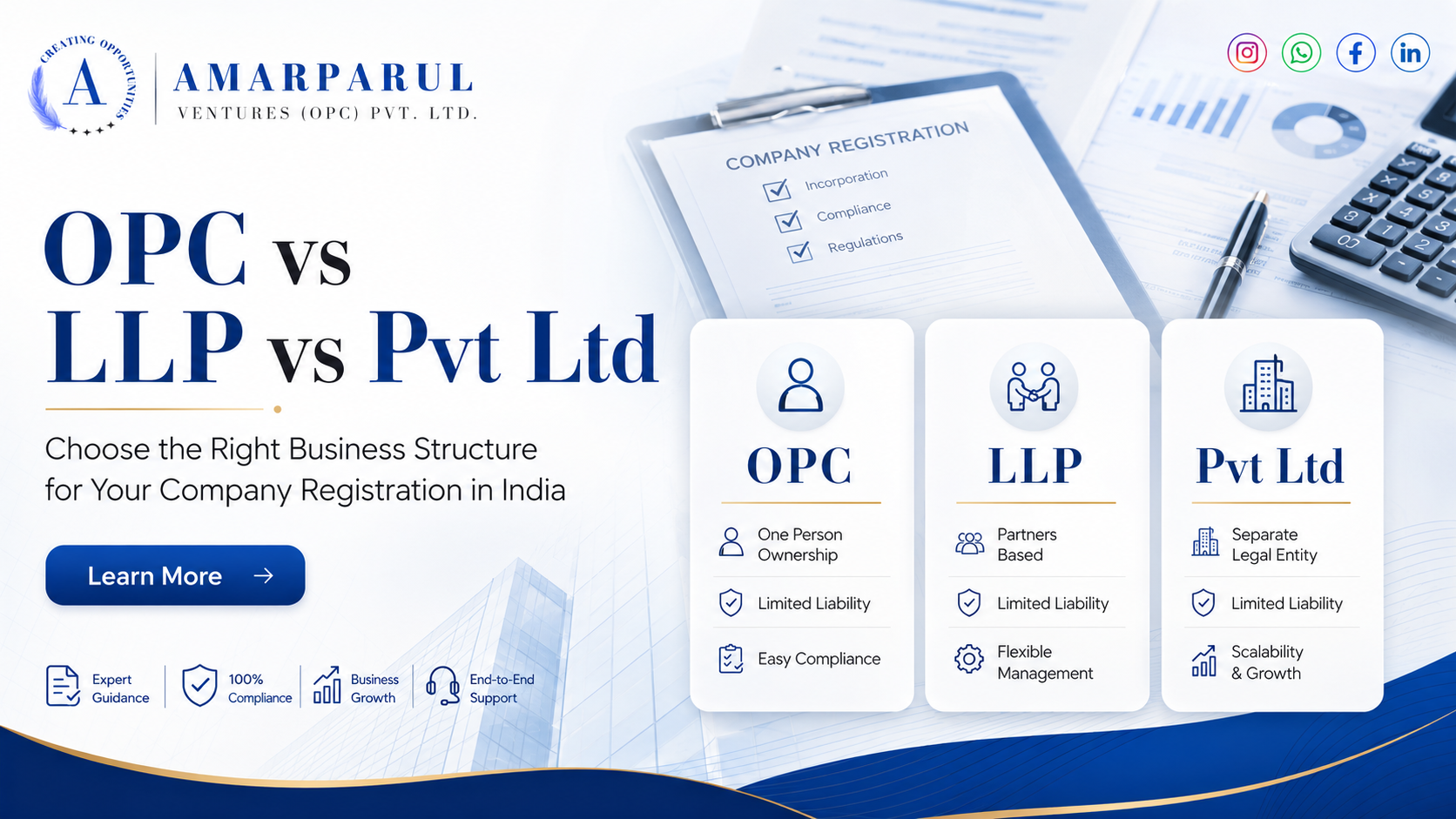
Choosing the right business structure is one of the first important decisions for any entrepreneur, startup founder, consultant, professional, freelancer or small business owner. Many people start with a simple question: should I register an OPC, LLP or Private Limited Company?
At first, all three options may look similar because they offer a separate legal identity and limited liability protection. But when you look closely, there are major differences in ownership, compliance, taxation, funding, credibility, flexibility and long-term business growth.
For example, a solo business owner may prefer an OPC. Two professionals starting a consulting firm may find an LLP more practical. A startup planning to raise funds may choose a Private Limited Company. So, there is no single answer that fits every business.
In this blog, we will explain the difference between OPC, LLP and Pvt Ltd Company in simple words, so you can understand which business structure is suitable for your business before starting the company registration process in India.
What Are OPC, LLP and Private Limited Company?
Before comparing OPC vs LLP vs Pvt Ltd, it is important to understand what each structure means.
What is OPC?
OPC stands for One Person Company. As the name suggests, it is a company that can be started by one person. It is suitable for solo entrepreneurs who want to run a business under a proper company structure without adding another shareholder.
An OPC gives the owner a separate legal identity and limited liability protection. This means the business and the owner are treated separately in the eyes of law. Compared to a proprietorship, an OPC usually gives better credibility because it is registered as a company.
OPC is commonly suitable for individual consultants, freelancers, solo founders, small business owners and professionals who want a formal business structure but do not have partners at the beginning.
However, OPC also has certain limitations. Since it is designed for a single owner, it is not as flexible as a Private Limited Company when it comes to adding investors, co-founders or multiple shareholders.
What is LLP?
LLP stands for Limited Liability Partnership. It is a business structure where two or more partners can run a business together with limited liability protection.
An LLP is different from a traditional partnership firm because it has a separate legal identity. The partners are not personally liable for all business liabilities in the same way as a normal partnership, subject to legal exceptions.
LLP is usually preferred by professionals, consultants, service businesses, agencies, family businesses and small firms where partners want flexibility in profit sharing and management. The internal rules of an LLP are generally governed by an LLP agreement.
One major reason people choose LLP is that it offers more flexibility and generally has a simpler compliance burden compared to a Private Limited Company.
What is Private Limited Company?
A Private Limited Company, commonly called Pvt Ltd, is one of the most popular business structures in India for startups, growing businesses and companies planning expansion.
A Pvt Ltd company has shareholders and directors. Shareholders own the company, while directors manage the company. This structure is more formal and is generally preferred when a business wants to raise funds, issue shares, add investors, create ESOPs or build a scalable company.
Private Limited Companies usually have stronger credibility with investors, banks, corporate clients, vendors and large institutions. But they also come with higher compliance requirements compared to LLP and OPC.
If your business has long-term growth plans, multiple founders, investor funding goals or expansion plans, a Private Limited Company is often the preferred choice.

Quick Comparison: OPC vs LLP vs Pvt Ltd
Here is a simple comparison table to understand the difference between OPC, LLP and Pvt Ltd Company.
| Point of Difference | OPC | LLP | Pvt Ltd |
| Full Form | One Person Company | Limited Liability Partnership | Private Limited Company |
| Best Suitable For | Solo business owner | Two or more partners | Startups and growing businesses |
| Minimum Owners | 1 member | 2 partners | 2 shareholders |
| Separate Legal Entity | Yes | Yes | Yes |
| Limited Liability | Yes | Yes | Yes |
| Ownership Structure | Single owner | Partners | Shareholders |
| Management | Director | Designated partners | Directors |
| Compliance Level | Moderate | Generally lower | Higher |
| Funding Friendly | Limited | Less preferred by investors | Highly preferred |
| Investor Entry | Difficult compared to Pvt Ltd | Not ideal for equity funding | Easier through shareholding |
| Suitable for Startups | Good for solo founder | Good for service startups | Best for scalable startups |
| Suitable for Small Business | Yes | Yes | Yes |
| Public Credibility | Good | Good | Strong |
| Flexibility | Limited | High | Structured |
| Conversion Possibility | Can be converted, subject to rules | Can be converted, subject to rules | Already scalable |
This table gives a quick idea, but the right choice depends on your business model, number of owners, future goals and compliance readiness.
Difference Between OPC, LLP and Pvt Ltd Based on Ownership
Ownership is one of the biggest differences between OPC, LLP and Pvt Ltd.
In an OPC, there is only one owner. That person holds the ownership and controls the business. A nominee is also required, but the nominee does not become the owner unless a specific event happens as per the applicable rules.
In an LLP, ownership belongs to the partners. The partners can decide their profit-sharing ratio and responsibilities through the LLP agreement. This makes LLP flexible for professional firms, agencies, consulting businesses and partnerships.
In a Private Limited Company, ownership belongs to shareholders. The company is managed by directors. This structure is more suitable when ownership may change in the future through share transfer, new investment, ESOPs or investor participation.
So, if you are a single owner, OPC can be considered. If you have partners, LLP may be suitable. If you want co-founders, investors and structured ownership, Pvt Ltd is usually better.
Difference Based on Liability Protection
OPC, LLP and Pvt Ltd all provide limited liability protection. This is one of the main reasons entrepreneurs prefer these structures over a simple proprietorship or traditional partnership.
Limited liability means the personal assets of the owner, partners or shareholders are generally protected from business liabilities. However, this protection is not absolute in every situation. If there is fraud, personal guarantee, legal violation, tax default or misuse of the entity, personal responsibility may still arise.
In an OPC, the liability of the member is generally limited to the unpaid amount on shares, if any.
In an LLP, partners usually have limited liability. One partner is generally not personally liable for the independent wrongful act of another partner, subject to the legal facts of the case.
In a Pvt Ltd company, shareholders have limited liability based on their shareholding. The company itself is a separate legal person.
From a practical point of view, all three structures offer better protection than an unregistered business or proprietorship. But proper compliance, accounting, tax filing and documentation are necessary to maintain that protection.
Difference Based on Compliance Requirements
Compliance is a very important factor while choosing between OPC, LLP and Pvt Ltd.
Many business owners only think about registration cost, but the real responsibility starts after registration. Every registered business must maintain proper records, file returns and follow applicable laws.
OPC Compliance
An OPC has moderate compliance requirements. It is simpler than a full Private Limited Company in some cases, but still it is a company, so annual compliance cannot be ignored.
Common OPC compliance may include annual filing, income tax return filing, financial statements, director-related compliance, accounting records and ROC-related filings.
OPC can be a good option for a solo entrepreneur who wants a proper company structure but is ready to handle basic annual compliance.
LLP Compliance
LLP compliance is generally considered simpler compared to a Private Limited Company. An LLP usually needs to file annual returns and a statement of accounts and solvency. It also needs to file income tax returns and maintain proper books of accounts.
Because LLP has fewer corporate governance requirements compared to Pvt Ltd, many small firms and professional businesses prefer LLP.
However, simpler compliance does not mean no compliance. LLPs must still file required forms on time. Delayed filings can lead to penalties.
Pvt Ltd Compliance
A Private Limited Company has more formal compliance requirements. It has to maintain statutory registers, conduct board meetings, appoint an auditor, file annual returns, prepare financial statements, complete ROC filings, maintain books of accounts and follow director-related compliance.
This may sound like extra work, but it also gives Pvt Ltd companies a stronger legal and governance structure. That is why investors, banks and larger clients often prefer dealing with a Private Limited Company.
If you are planning a serious, scalable and investment-ready business, these compliance requirements should be seen as part of building a strong company foundation.

Difference Based on Taxation
Taxation is another important point when comparing OPC vs LLP vs Pvt Ltd. However, it is important to understand one thing clearly: tax should not be the only reason for choosing a business structure.
An LLP and a company are taxed differently. A Private Limited Company is taxed as a domestic company. An LLP is generally taxed under the partnership firm/LLP category. An OPC is also a company, so company taxation rules apply.
The actual tax impact depends on profit, turnover, deductions, business activity, applicable tax regime, surcharge, cess and other provisions. Tax rules may also change from time to time.
Many people ask, “Which is better for tax, LLP or Pvt Ltd?” The answer depends on your business situation. Sometimes LLP may look simple from a tax and compliance point of view. In other cases, Pvt Ltd may be more suitable due to reinvestment, funding, business credibility and long-term planning.
A good CA will not only compare tax rates. They will also check your business model, expected profit, owner withdrawals, funding plans, compliance cost and future conversion possibilities before suggesting the right structure.
Difference Based on Registration Process
OPC, LLP and Pvt Ltd registration can be done online through the MCA process. But the documentation and forms may differ depending on the type of entity.
OPC Registration Process
The basic OPC registration process usually includes:
First, the proposed director needs a Digital Signature Certificate. Then the company name is applied for approval. After that, incorporation documents are prepared, including details of the member, nominee, registered office and business activity. Once the forms are filed and approved, the Certificate of Incorporation is issued.
OPC registration is suitable when one person wants to start a company without bringing in another shareholder.
LLP Registration Process
For LLP registration, the designated partners need Digital Signature Certificates. Name approval is applied through the MCA process. After approval, incorporation forms are filed. Once the LLP is incorporated, the LLP agreement must be prepared and filed within the required timeline.
The LLP agreement is very important because it defines partner rights, profit sharing, duties, capital contribution and decision-making rules.
Pvt Ltd Registration Process
For Private Limited Company registration, directors need Digital Signature Certificates. The name is applied for approval. Then incorporation documents such as MOA and AOA are prepared and filed through the MCA process. After approval, the company receives its Certificate of Incorporation along with PAN and TAN as applicable.
A Pvt Ltd company registration should be planned properly, especially if there are multiple founders, different shareholding ratios or future investors.
Documents Required for OPC, LLP and Pvt Ltd Registration
The documents required may vary based on the case, but generally, the following documents are commonly needed.
For individuals, PAN card, Aadhaar card, photograph, mobile number, email ID, identity proof and address proof are usually required.
For the registered office, an electricity bill or utility bill, rent agreement or ownership proof and NOC from the owner may be needed.
For OPC, nominee details and nominee consent are also required.
For LLP, partner details and LLP agreement are important.
For Pvt Ltd, details of directors, shareholders, shareholding pattern, MOA and AOA are required.
A CA or company registration consultant can help prepare and verify documents properly before filing, so unnecessary rejection or delay can be avoided.
Cost Difference Between OPC, LLP and Pvt Ltd
The cost of registration depends on different factors such as state, stamp duty, professional fees, number of partners or directors, authorised capital, DSC, documentation and additional registrations.
Generally, LLP may have comparatively lower compliance and maintenance cost. OPC may have moderate cost because it is a company structure for a single owner. Pvt Ltd may have higher compliance cost, but it also gives better scalability and credibility.
Here is a simple cost comparison:
| Cost Factor | OPC | LLP | Pvt Ltd |
| Registration Cost | Moderate | Usually moderate | Moderate to higher |
| Annual Compliance Cost | Moderate | Usually lower | Higher |
| Documentation | Moderate | Moderate | More structured |
| Professional Fees | Depends on work | Depends on work | Depends on work |
| Best for Low Compliance | Not the lowest | Better option | Not ideal |
| Best for Growth | Limited | Moderate | Strong |
Many business owners make the mistake of choosing an entity only because registration cost is low. This is not the right approach. A cheaper structure today may become restrictive tomorrow if your business grows, adds investors or changes ownership.
Which is Better for Startups: OPC, LLP or Pvt Ltd?
For startups, the answer depends on the future plan.
If you are a solo founder testing an idea and do not need investors immediately, OPC may work at the beginning.
If two or more people are starting a service-based business, consulting firm, agency or professional practice, LLP can be a practical option because it offers flexibility and limited liability.
If your startup plans to raise funding, issue shares, bring investors, create ESOPs, add co-founders or scale aggressively, Private Limited Company is usually the better structure.
Most investors prefer Pvt Ltd because it has a clear shareholding structure. Equity investment is easier to manage in a company compared to LLP or OPC.
So, if your startup is funding-focused, Pvt Ltd is generally the stronger choice.
Which is Better for Small Business?
For small businesses, there is no one fixed answer. It depends on ownership and future goals.
Choose OPC if you are a single owner and want limited liability with better credibility than a proprietorship.
Choose LLP if you have two or more partners and want flexibility with comparatively simpler compliance.
Choose Pvt Ltd if you want to build a brand, work with bigger clients, raise funds, add shareholders or create a scalable business structure.
For example, a solo digital consultant may choose OPC. Two chartered accountants or consultants may choose LLP. A tech product startup may choose Pvt Ltd.
The best structure is the one that supports your current business and future growth.
OPC vs LLP: Which One Should You Choose?
OPC and LLP are very different because OPC is for one person, while LLP requires at least two partners.
If you are starting alone, LLP is not suitable because LLP needs partners. In that case, OPC may be better if you want a registered company structure.
If you have a business partner and both of you want flexible management and profit sharing, LLP may be better than OPC.
OPC is more suitable for solo entrepreneurs. LLP is more suitable for partnership-based businesses.
LLP vs Pvt Ltd: Which One is Better?
This is one of the most common questions asked by business owners.
LLP is better when you want flexibility, simpler compliance and partner-based management. It is commonly used for consulting businesses, service firms, professional practices and small businesses.
Pvt Ltd is better when you want a scalable business structure, investor funding, shareholding flexibility, stronger corporate credibility and long-term expansion.
If your business is going to remain partner-managed and service-focused, LLP can be a good choice. If your business is going to grow with investors, employees, ESOPs, multiple shareholders and expansion plans, Pvt Ltd is usually better.
OPC vs Pvt Ltd: Which One is Better?
OPC is suitable for one person. Pvt Ltd is suitable for two or more shareholders.
If you are a single owner and want full control, OPC can be a practical option. But if you want to add co-founders, investors or shareholders, Pvt Ltd is better.
A Private Limited Company is more flexible for growth because ownership can be divided into shares. Investors can be added through share allotment or transfer, subject to applicable laws and agreements.
So, OPC is good for a solo start. Pvt Ltd is better for long-term scalability.

Common Mistakes People Make While Choosing a Business Structure
Many business owners register an entity without proper advice and later face compliance, tax or ownership problems. Here are some common mistakes to avoid.
Some people choose Pvt Ltd only because it sounds bigger, without understanding the compliance cost.
Some choose LLP only because it has simpler compliance, without thinking about future investors.
Some start OPC without considering whether they may need co-founders in the near future.
Some people ignore tax planning and only look at registration charges.
Some do not prepare a proper LLP agreement or shareholders’ understanding.
Some do not check name availability properly.
Some ignore annual compliance after registration and later face penalties.
Some choose a structure based on advice from friends instead of consulting a professional.
The right business structure should be selected after checking ownership, liability, tax, compliance, funding, future expansion and exit planning.
Practical Examples: Which Structure Fits Which Business?
Let us understand with simple examples.
Example 1: Solo Consultant
A single business consultant wants to work with corporate clients and wants better credibility than a proprietorship. In this case, OPC can be a suitable option.
It gives a company structure and limited liability while allowing the person to run the business independently.
Example 2: Two Friends Starting a Marketing Agency
If two friends are starting a marketing agency and want flexible profit sharing, LLP can be suitable.
But if they want to build a large agency, raise funds or add shareholders later, Pvt Ltd may be better.
Example 3: Tech Startup Planning Investor Funding
A technology startup planning to raise investment should usually consider Private Limited Company.
This is because investors generally prefer a proper shareholding structure, which is easier in a Pvt Ltd company.
Example 4: Professional Services Firm
A firm of consultants, architects, tax professionals or advisors may prefer LLP because it gives flexibility and limited liability.
LLP works well where partners are actively involved in business operations.
Example 5: Family-Owned Business
A family business may choose LLP or Pvt Ltd depending on its size and growth plan.
If the business is small and partner-managed, LLP can be suitable. If the family wants to build a larger brand, expand operations and create a formal structure, Pvt Ltd may be better.
Final Decision Guide: OPC, LLP or Pvt Ltd?
Here is a simple decision guide:
| Your Situation | Recommended Structure |
| You are a single owner | OPC |
| You have two or more partners | LLP or Pvt Ltd |
| You want lower compliance | LLP |
| You want investor funding | Pvt Ltd |
| You want to issue shares | Pvt Ltd |
| You are starting a professional firm | LLP |
| You are starting a scalable startup | Pvt Ltd |
| You want full control as a solo owner | OPC |
| You want strong business credibility | Pvt Ltd |
| You want flexible partner profit sharing | LLP |
This table gives general guidance. The final decision should be taken after understanding your business activity, tax position, number of owners, investment plans and compliance capacity.
How a CA Can Help You Choose the Right Business Structure
A CA plays an important role before and after business registration.
A CA can help you compare OPC, LLP and Pvt Ltd based on your actual business advisory & planning. They can guide you on tax impact, compliance cost, documentation, registration process, accounting setup, GST registration, ROC filing and annual compliance.
A professional can also help you avoid mistakes such as choosing the wrong structure, incorrect shareholding, weak LLP agreement, poor documentation or missed compliance deadlines.
If you are confused between OPC, LLP and Pvt Ltd, it is always better to take professional advice before registration rather than correcting mistakes later.
Conclusion
The difference between OPC, LLP and Pvt Ltd Company is not only about registration. It is about ownership, liability, tax, compliance, funding, credibility and future growth.
OPC is suitable for a single owner who wants a company structure.
LLP is suitable for two or more partners who want flexibility and comparatively simpler compliance.
Private Limited Company is suitable for startups, growing businesses and companies planning funding or expansion.
There is no one-size-fits-all answer. The best business structure depends on your business model, number of owners, long-term vision and financial advisory & planning.
If you are planning to register your business but are confused between OPC, LLP and Pvt Ltd, speak with our CA experts. We can help you choose the right structure and complete your business registration process with proper documentation and compliance guidance.
FAQs on Difference Between OPC, LLP and Pvt Ltd
Q1. What is the main difference between OPC, LLP and Pvt Ltd?
The main difference is ownership and business purpose. OPC is suitable for one person. LLP is suitable for two or more partners. Pvt Ltd is suitable for startups and growing businesses that need structured ownership, investors and scalability.
Q2. Which is better: OPC, LLP or Pvt Ltd?
It depends on your business goal. OPC is better for solo entrepreneurs. LLP is better for partner-based businesses and professional firms. Pvt Ltd is better for startups, funding and long-term growth.
Q3. Which has less compliance: LLP or Pvt Ltd?
Generally, LLP has simpler compliance compared to a Private Limited Company. However, LLP still needs proper annual filing, tax filing and accounting.
Q4. Is Pvt Ltd better than LLP?
Pvt Ltd is better if you want funding, shareholders, ESOPs, investor entry and strong corporate credibility. LLP is better if you want flexibility, partner-based management and comparatively simpler compliance.
Q5. Which is better for a single owner: OPC or Pvt Ltd?
For a single owner, OPC is usually more suitable because it is designed for one person. Pvt Ltd requires at least two shareholders.
Q6. Can OPC be converted into Pvt Ltd?
Yes, OPC may be converted into a Private Limited Company subject to applicable rules and conditions. It is better to consult a professional before planning conversion.
Q7. Is LLP good for startups?
LLP can be good for service-based startups, consulting businesses and professional firms. But if a startup is planning to raise investor funding, Pvt Ltd is generally preferred.
Q8. Which is best for funding: LLP or Pvt Ltd?
Private Limited Company is generally better for funding because it has a proper shareholding structure. Investors usually prefer Pvt Ltd companies over LLPs.
Q9. Which is cheaper to maintain: LLP or Pvt Ltd?
LLP is generally cheaper and simpler to maintain compared to Pvt Ltd. However, the actual cost depends on business activity, turnover, compliance requirements and professional support.
Q10. Do I need a CA for OPC, LLP or Pvt Ltd registration?
Yes, it is highly recommended. A CA can help you choose the right structure, prepare documents, complete registration, plan taxes and manage annual compliance properly.